



The Office of the United States Trade Representative (USTR) released the latest tariff exemption list in April 2025, and three types of precision metal parts, including high-precision bearings, aviation fasteners and robot reducers, were selected.
Policy core: technical threshold and market gap
1.High-speed bearings (HS 8482 category)
Exemption standard: Machine tool spindle bearings with a speed ≥ 25,000rpm, China accounts for 61% of global production capacity. The North American Machine Tool Association pointed out that the United States can only meet 19% of high-end demand.
2.Aerospace-grade fasteners (HS 7318 category)
TC4 titanium alloy bolt tensile strength threshold increased to 1,300MPa, Chinese manufacturers use powder metallurgy near-net forming technology, and material utilization rate is increased by 53% compared with traditional processes.
3.Robot reducer (HS 8503 category)
After the tariff exemption of harmonic reducers, the price of Chinese products is 40% lower than that of Japanese brands. Boston Consulting predicts that the North American market share will reach 24% in 2027.
Key data of industrial chain transformation
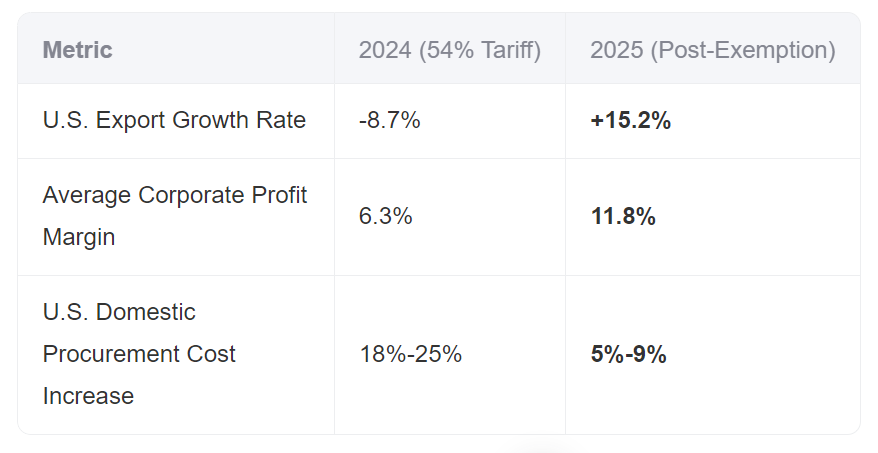
Analysis of benchmark enterprise capabilities: Mid Precision Manufacturing
As a leading metal precision parts manufacturing company, Mid Precision has seized the tariff exemption dividend with three core advantages:
Hard-core production capacity: 7,500 square meters of modern factory, equipped with five-axis linkage machining center, industrial CT and three-coordinate detection system
Cross-industry qualifications: AS9100D aerospace certification, ISO 13485 Medical Device System Certification
Technology Moat:
Processing of complex special-shaped parts: mass production of curved parts with a tolerance of ±1.5μm can be achieved
One-stop service: full process coverage from topological structure optimization design to surface nano-coating treatment
Special process certification: passed NADCAP heat treatment and non-destructive testing certification
Market Outlook: With the improvement of the dynamic adjustment mechanism of the tariff exemption policy, companies with multi-industry certification matrices, agile supply chains and technology premium capabilities will have the strategic initiative in the competition and cooperation between China and the United States in high-end manufacturing.


