



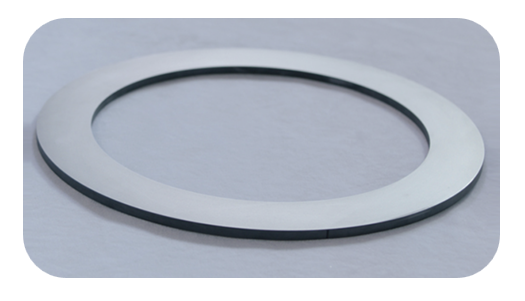
In the field of chip manufacturing, the processing quality of single-crystal silicon rings as core workpieces directly affects the performance of semiconductor devices. A batch of D360mm single-crystal silicon rings processed by a certain company recently faced three major problems under the traditional grinding process: low efficiency, many surface defects, and easy cracking of thin walls due to their complex structure (including inner circle, outer circle, plane and step features).
Processing background and industry pain points
Single-crystal silicon rings need to go through multiple processes such as roughing and finishing, and their thin-walled structure (thickness is only 1.2mm) requires extremely high processing stability. The traditional process uses grinding wheels for grinding, but there are obvious shortcomings:
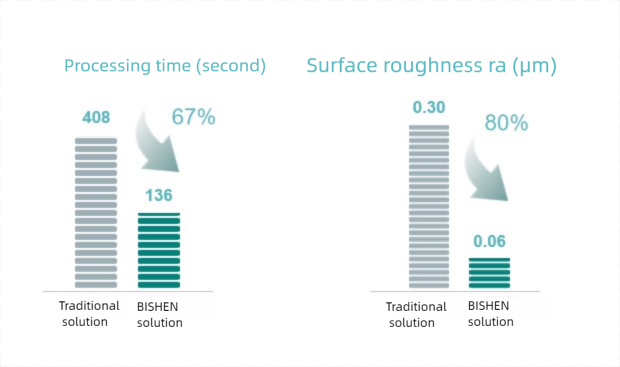
Low efficiency: Single-piece processing takes up to 408 seconds, which is difficult to match mass production requirements;
Poor surface quality: The roughness after grinding is only Ra 0.30μm, and additional polishing is required;
Serious yield loss: The chipping rate in the thin-walled area exceeds 15%, and the material loss cost is high.
MID solutions: Ultrasonic precision engraving and milling technology is implemented
In view of the characteristics of monocrystalline silicon, the MID technical team proposed an innovative process solution:
Ultrasonic precision engraving and milling: Reduce cutting resistance through high-frequency vibration tools to avoid concentrated force on thin-walled structures;
DDR vertical high-speed turntable: With multi-axis linkage control, realize one-time forming of contour surfaces and reduce repeated clamping;
Customized cutting parameters: Optimize feed rate and cutting depth for the brittle and hard characteristics of monocrystalline silicon.
Processing efficiency breaks through industry benchmarks
Actual production data shows that the new solution has achieved three major improvements:
Efficiency increased by 67%: Single-piece processing time is shortened from 408 seconds to 136 seconds;
Surface roughness reduced by 80%: Reaching Ra 0.06μm, meeting direct assembly requirements;
Failure rate approaches zero: Ultrasonic technology effectively suppresses micro cracks and increases material utilization by 20%.
About MID
MID focuses on technology research and development and equipment integration in the field of high-precision machining, and is committed to providing customized solutions for the semiconductor, optical and medical device industries. The company's team is deeply engaged in superhard material processing technology, and has served more than 100 manufacturing companies around the world. Its core technologies include ultrasonic machining, five-axis linkage and intelligent process optimization systems.


