



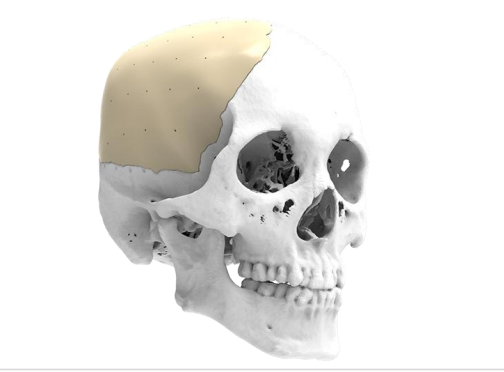
Special proposition of medical precision machining
In the field of skull repair, PEEK (polyetheretherketone) material has become the preferred substrate for high-end implants due to its elastic modulus and biosafety that is highly compatible with human bones. A customized artificial skull project undertaken by a medical technology company requires high-precision drilling on an irregular craniofacial bone structure of 200x200mm. It is necessary to maintain the biological activity of the material and meet the clinical requirements of zero burrs on the implant surface, which poses a double challenge to the processing technology.
Clinical-level defects of traditional processes
When the company initially adopted the five-axis linkage milling solution, it was found that:
The processing time of a single piece was as long as 8 hours, which affected the patient's treatment cycle
The residual burr rate on the edge of the hole reached 92%, requiring 3 technicians to manually handle it
Cutting heat caused local material carbonization, adding a secondary cleaning process
The production supervisor admitted: "Manual deburring is not only inefficient, but also has hidden quality risks."
MID solutions break the deadlock
In view of the heat-sensitive and easy-to-chip characteristics of PEEK materials, the MID technical team built a composite processing system:
Ultrasonic green engraving and milling platform: 40kHz high-frequency vibration to achieve "micron-level" material peeling
Low-temperature internal cooling system: -5℃ cold air directly reaches the tip of the tool to suppress processing temperature rise
Five-axis rotary table linkage: Adaptive surface maintains 90° vertical entry
Special tool coating: PTFE composite material reduces friction coefficient
Breakthrough in medical-grade processing standards
After the implementation of the solution, multi-dimensional improvements were achieved:
• The processing cycle of a single piece was compressed to 5.6 hours, increasing the speed by 30%
• The life of the cutting edge was extended by 30%, and the tool cost was significantly reduced
• The burr residual rate is less than 0.5%, reaching the direct assembly standard
• No water or oil stains during the whole process, saving 75% of cleaning consumables


