



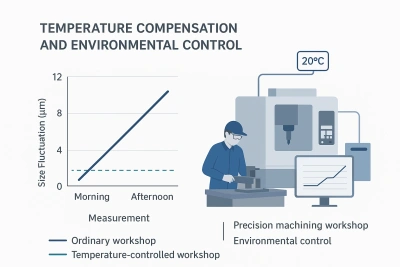
In precision machining, many assume that dimensional accuracy is determined mainly by cutting tools or machine parameters. In reality, the decisive factor often lies in the environment.
Why Environmental Control is Standard in Western Manufacturing
In high-end European and American workshops, climate-controlled environments are considered basic infrastructure:
Temperature control: 20℃ ±1℃
Humidity control: 40–60%
Machine setup: real-time temperature compensation systems
Metals expand or contract with temperature fluctuations. Even a small change can introduce micron-level errors. For example, steel has a thermal expansion coefficient of 11.5 μm/m·K. A 1-meter workpiece will grow 11.5 μm with just a 1℃ rise.
This is why Western manufacturers confidently demand ±5 μm or even ±2 μm tolerances-because their environment ensures consistency between machining results and final inspection.
The Challenge in Typical Workshops
In many Asian workshops, the temperature can swing widely:
Summer shop floor: 35℃
Winter shop floor: 5℃
Daily variation: >10℃
Under these conditions, even with the same machine, same tool, and same program, measurements taken in the morning vs. afternoon may differ by 10–15 μm.
Many first blame tool wear or machine accuracy. But the real root cause is temperature drift.
Comparison under the same machining process:
| Environment | Dimensional Stability | Variation Range |
|---|---|---|
| Climate-controlled room (20℃ ±1℃) | High stability | ±2 μm |
| Normal workshop (>10℃ fluctuation) | Unstable | ±12 μm |
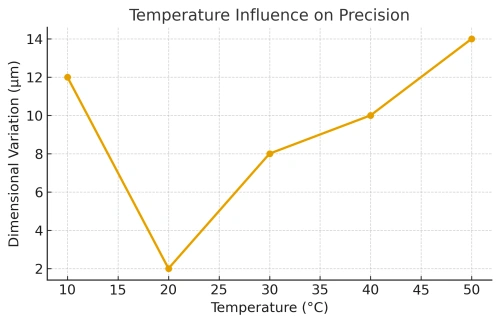
Temperature-Precision Curve
Our Solution: Climate-Controlled Rooms + Temperature Compensation
To meet aerospace, medical, and high-precision requirements, we have built a climate-controlled machining workshop:
Constant 20℃ ±1℃ year-round
Preheating for machines to achieve thermal balance
Real-time temperature compensation to correct dimensional drift
Unified inspection environment to ensure measurement matches machining
This ensures that both machining and inspection occur under the same baseline, eliminating discrepancies such as "parts look correct on the machine but fail during measurement."
Why This Matters to Western Customers
For aerospace, medical, and semiconductor manufacturers, environmental control is not an option but a requirement.
Without stability, "precision machining" is just a slogan.
With stability, ±2–5 μm tolerances become truly achievable.
That's why certifications (AS9100, ISO13485) demand environmental control.
Conclusion
Tools and machines matter-but environmental stability is the hidden key to real precision.
By combining climate-controlled workshops with temperature compensation, we ensure that every part we deliver achieves consistent, verifiable accuracy.


