



In precision metal machining projects, thin-wall components are often the most demanding parts to manufacture. Their geometric structures are inherently prone to deformation due to stress release, especially in aerospace, medical, and high-precision equipment industries. Even a deviation as small as 0.05 mm can lead to assembly failure or performance loss of the entire system.
In the European and American markets, engineers pay far more attention to thin-wall parts compared to common domestic practices. They not only check whether the part meets "as-machined tolerance," but also focus on its stability in real assembly conditions. This is why machining strategies are more refined:
1. Step Cutting
Thin-wall parts tend to warp under heavy, one-pass cutting. We adopt step cutting, gradually removing layers and measuring stress release at each stage to ensure the part adapts progressively to cutting stress.
Case Example:
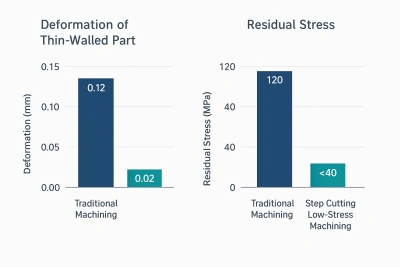
For an aerospace-grade aluminum alloy cabin structure, traditional one-pass cutting caused 0.12 mm warpage. With step cutting, warpage was reduced and controlled within 0.02 mm.
2. Zoned Fixturing
Using a single fixture often causes uneven stress distribution, resulting in deformation. We apply zoned fixturing, dynamically adjusting clamping areas based on part geometry and tool path to maintain balanced forces.
Comparison:
- Standard fixture: warpage after unclamping 0.08–0.15 mm
- Zoned fixturing: warpage after unclamping ≤ 0.03 mm
3. Low-Stress Machining
By reducing cutting speed, depth, and feed rate, we allow the material to gradually release internal stress instead of "tearing it apart" in one go.
Result:
For high-strength aluminum alloy thin-wall parts, residual stress was reduced from 120 MPa to <40 MPa under low-stress machining, significantly improving assembly stability.
Why Do European and American Customers Value These Processes?
In Europe and the U.S., manufacturers emphasize full lifecycle reliability of components. Even if a part meets dimensional tolerance, any warpage or failure after assembly is treated as a critical quality issue. That's why we treat as-machined accuracy and assembly usability as two independent, equally strict control metrics.
For example, in aerospace cabin structure machining, we:
- Conduct simulated clamping tests to evaluate stress distribution
- Apply step cutting while recording stress release at each stage
- Adjust tool paths and fixture layout when necessary
Although this process takes more time, it ensures parts remain stable and reliable in real assembly, reducing downstream assembly risks and maintenance costs.
Our Commitment
We integrate these seemingly "complicated" processes into our standard operating practice. For European and American clients, this means:
- High-precision parts that are both dimensionally accurate and assembly-stable
- Lower assembly defect rates, reduced rework and maintenance costs
- Reliable long-term performance that meets aerospace, medical, and high-end equipment standards


