



In working with European and American clients in the field of precision CNC machining, we've realized the critical importance of surface roughness (Ra/Rz) for part performance, especially in high-demand applications such as high-pressure cylinders and optical components. European and American customers often have strict surface roughness requirements in their drawings, typically specifying precision levels such as 3.2 µm, 1.6 µm, 0.8 µm, 0.4 µm depending on specific functional needs. These requirements not only affect the appearance but directly influence the sealing performance, fit, and wear resistance of parts.
Blind Spot in Domestic Workshops
However, in many domestic workshops, surface roughness control often has significant blind spots. Many factories focus only on visible surface finish and pursue smoothness, but they often ignore the precise control of Ra values based on functional requirements. For example, while a part may appear visually smooth and meet the visual finish requirement, it might not meet the client's actual needs, such as the sealing performance of high-pressure cylinders or the reflective properties of optical components.
Selection of Surface Roughness Ra and Rz
Ra (Arithmetic Mean Roughness)
Ra is the most commonly used surface roughness parameter, representing the arithmetic average deviation of the surface profile. The selection of Ra is usually closely related to the functional requirements of the part. For example, for high-pressure cylinders, a high Ra value might result in poor sealing, while too low a Ra value could lead to excessive processing costs. Common Ra specifications for optimal sealing and performance are 1.6 µm or 0.8 µm.
Rz (Ten-Point Height)
Rz is another commonly used surface roughness parameter, representing the maximum height variation of the surface over a specified length. Rz is often used for applications requiring more detailed surface requirements, such as optical components. In these applications, surface roughness must meet stricter standards, with Rz often required to be less than 0.4 µm to ensure optical performance.
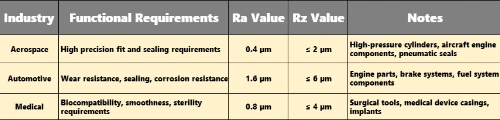
Surface Roughness Selection Comparison Table
To clearly show the differences in surface roughness selection across industries, here's a comparison for the aerospace, automotive, and medical industries:
How Mid Scientifically Selects Surface Roughness
In our precision metal machining process, selecting the appropriate surface roughness is not just about meeting aesthetic requirements, but rather scientifically determining the Ra and Rz values based on the part's functional needs. Here's the selection process we recommend to clients:
Clarify Functional Requirements
We communicate with our clients to understand the part's functional requirements, such as sealing, wear resistance, surface fitting, etc., which will guide the surface roughness selection.
Select the Appropriate Ra/Rz
Based on industry standards and the part's function, we select the suitable Ra/Rz precision. For example, high-pressure cylinders and engine components may require Ra 1.6 µm, while medical implants may require lower Ra values like 0.8 µm.
Optimize Production Process
After selecting the surface roughness, we implement precise machining processes to ensure that each part meets the strict Ra/Rz requirements. We use advanced CNC machines and ultra-precision grinding technology to achieve fine control.
Precise Inspection and Control
Using roughness meters and CMM (Coordinate Measuring Machines), we precisely measure and control each part's surface roughness to ensure it meets functional requirements after production.
Conclusion
Surface roughness is not just about appearance-it has a critical impact on the part's performance, reliability, and functionality. European and American clients have strict and precise Ra/Rz requirements. To meet these standards, we continuously enhance our fine control over surface roughness, ensuring that parts perform optimally in high-demand applications.
As a company specializing in precision metal machining, we understand the importance of surface roughness in different parts. By precisely controlling Ra/Rz, we can provide more reliable products that meet the high standards of clients in industries like aerospace, automotive, and medical.


