



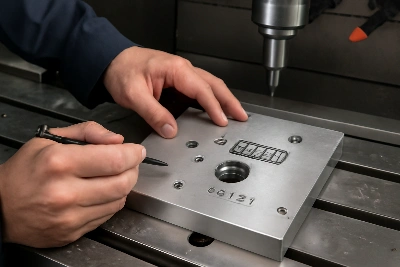
In working with European and American customers in the field of precision CNC machining, I've noticed a key difference: their drawings almost always use GD&T (Geometric Dimensioning and Tolerancing) to define requirements, while many factories in China still rely only on linear dimensions.
For example, if a drawing only specifies the diameter and location of a hole, many shops will machine the hole and check if the number is within tolerance. If it is, they consider it "qualified." But in industries like aerospace manufacturing, automotive CNC machining, or medical device manufacturing, what really determines whether the part will function properly are factors like true position, concentricity, and perpendicularity. Ignoring GD&T often leads to assembly issues-parts may bind, loosen, or even cause complete system failure.
We've seen this first-hand in our CNC machining practice. Take fastener holes in aerospace structures: if you only control diameter without following GD&T position requirements, cumulative deviations can cause dozens of holes to misalign during assembly. By strictly following the GD&T callouts on the drawing and using a CMM (Coordinate Measuring Machine) to check flatness, true position, and coaxiality, we ensure every critical feature is within tolerance. The result: our customer could assemble the structure smoothly on the first attempt.
Linear Dimensions vs. GD&T
| Aspect | Linear Dimensions | Geometric Dimensioning & Tolerancing (GD&T) |
|---|---|---|
| Expression | Numeric values for size and location (e.g., Ø10 ±0.05, X=50 ±0.1) | Symbols + datum references (e.g., ⌀0.1 |
| Control Target | Single value range | Shape, orientation, position, runout |
| Typical Features | Length, diameter, thickness | Flatness, parallelism, concentricity, true position, circular runout |
| Inspection Tools | Calipers, micrometers | CMM, dedicated gauges |
| Assembly Result | Size may be correct but fit may be tight/loose | High-precision fit and interchangeability |
| Applications | General parts, low precision requirements | Aerospace, automotive, medical-high reliability |
| Value | Lower cost, easier to apply | Ensures functionality, global interchangeability, reduced assembly risk |
Why Do European and American Customers Emphasize GD&T?
The value of GD&T is clear:
Interchangeability: Parts from different batches fit together seamlessly in precision machining.
Reliability: Prevents premature wear, fatigue, or failure caused by minor deviations in CNC machined parts.
Consistency: In global supply chains, parts from different factories still match perfectly, which is crucial for industries like medical device manufacturing and aerospace CNC machining.
For us, GD&T is more than just "understanding symbols." It's a common language we share with our customers in precision CNC manufacturing. By applying it in our CNC machining and inspection processes, we ensure the finished parts reflect the designer's true intent-and our customers have confidence when trusting us with their critical components.


