



Introduction: The Hidden Cost of Part Flipping
In precision machining, manufacturers often face challenges such as long production cycles, unstable part accuracy, and rising costs. Surprisingly, the root cause is not always cutting speed or tooling-but something much simpler: the number of times a part is flipped during machining.
Every flip requires extra setup, operator intervention, and re-alignment. This not only consumes valuable time but also introduces the risk of positioning errors and quality variations. For industries like aerospace, automotive, and medical machining, where tolerances are extremely tight, even small deviations can lead to scrap or rework.
That is why reducing part flipping has become a core strategy for advanced manufacturers in Europe and the U.S.
Why Flipping Matters in CNC Machining
Time Lost in Setups
Each repositioning adds non-cutting time and interrupts production flow.
Accumulated Errors
Even with skilled operators, every new setup risks misalignment that may affect dimensional accuracy.
Surface Quality Risks
Improper clamping or repeated handling can damage delicate surfaces, especially in aerospace components.
Cost Impact
Scrap, rework, and longer lead times all contribute to higher production costs.
4 Proven Strategies to Reduce Part Flipping
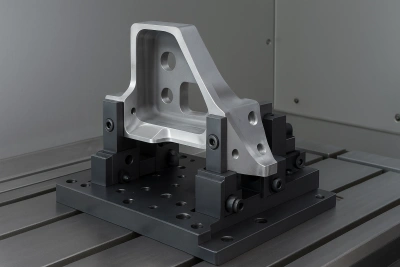
① Smarter Fixture Design
High-quality fixtures allow stable clamping and multi-face machining in one setup. Multi-side fixtures and rotary tables are widely adopted to reduce setup time and maintain consistency.
② Comprehensive Process Planning
By combining roughing, finishing, and multi-surface operations in a single setup, manufacturers minimize error accumulation. Holistic process planning ensures better workflow and reduces unnecessary handling.
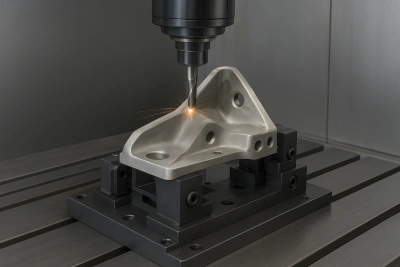
③ Multi-Axis Machining Technology
Five-axis CNC machining has become the standard for complex aerospace parts. With the ability to reach multiple surfaces without repositioning, it ensures higher accuracy, faster cycles, and fewer flips.
④ Automation & Robotics
Automated fixtures, robotic handling, and smart clamping systems reduce human error and improve repeatability. This trend is critical in high-volume production where consistency is key.
Case Study: Aerospace Component Optimization
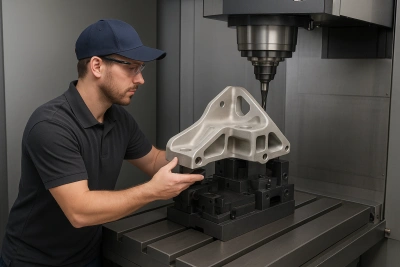
A leading aerospace supplier faced challenges with a structural aluminum component. The original process required five setups and frequent repositioning, leading to dimensional variation and long cycle times.
Our solution:
Designed a custom fixture to hold the part securely
Integrated machining operations into a single setup using a five-axis CNC machine
Results:
- Flipping reduced by 40%
- Dimensional accuracy improved by 20%
- Lead time reduced by 30%
- Scrap rate decreased significantly, saving thousands of dollars per batch
Benefits of Reducing Part Flipping
Higher Precision – Reduced error accumulation ensures tighter tolerances
Shorter Lead Times – Less setup = more cutting time
Lower Costs – Fewer scrap parts and reduced labor
Better Surface Quality – Less handling reduces scratches or damage
Stronger Competitiveness – Faster delivery and consistent quality for global customers
Conclusion: Turning Small Details into Big Advantages
Reducing part flipping is not just a minor adjustment-it's a strategic improvement that impacts efficiency, cost, and part quality. By optimizing fixture design, machining processes, multi-axis technology, and automation, manufacturers can transform small details into real competitive advantages.
At Mid Precision, we specialize in precision metal machining services for aerospace, automotive, and industrial customers. Our focus is on helping global clients reduce setup times, enhance machining efficiency, and achieve consistent quality.
👉 If you are exploring ways to optimize your CNC processes, we'd be glad to share more real-world case studies and solutions.


