



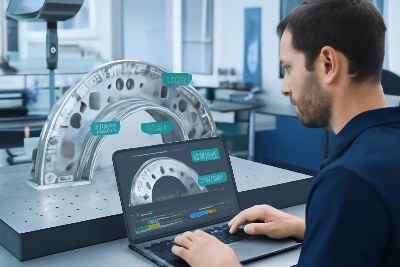
In the aerospace industry, modular assembly is a common approach for manufacturing complex structures, such as aircraft fuselages and cabin sections. Each section is made up of multiple parts that must align precisely during assembly. The critical challenge is ensuring that the final assembly error does not exceed 0.05 mm-a requirement that is crucial for maintaining overall structural integrity and aerodynamic performance.
The Challenge
While individual components may have tight tolerances, the cumulative tolerance across all parts in the assembly process can easily exceed the acceptable limit. Even small errors in each component can accumulate and result in an overall assembly that does not meet the required precision. This issue becomes more pronounced in larger, more complex assemblies where multiple parts are connected, and any misalignment can affect the final product's performance.
Cumulative error can lead to issues with fitting, which can compromise structural strength or affect aerodynamics.
Traditional measurement methods struggle to track small errors across multiple parts.
Manual error correction is inefficient and may not be precise enough for critical components.
Solution Approach
To tackle these precision challenges, we implemented a modular digital twin system that combines real-time data tracking with advanced machining techniques. This system enables continuous monitoring of part tolerances and error correction at each stage of the machining and assembly process.
Digital Twin Technology
Each component is equipped with sensors that track its dimensions, including any variations from the design. These sensors feed data into a digital twin system, allowing us to monitor and simulate the final assembly in real-time. This system ensures that any tolerance deviations are identified early in the process, allowing for immediate corrective action.
Real-Time Feedback and Correction
As each part is machined, its performance is compared to the digital model. If any discrepancies are detected, adjustments are made to the machining process in real-time, ensuring that subsequent parts align with the final assembly requirements.
Data-Driven Optimization
The digital twin allows for predictive modeling, which helps optimize machining paths, reduce waste, and prevent errors from accumulating in the later stages of production. This real-time feedback loop allows for a highly flexible, adaptive approach to manufacturing complex assemblies.
Precise Assembly Alignment
With the data captured from the digital twin, each modular section is assembled with pinpoint accuracy. The system dynamically adjusts the assembly process, making micro-level corrections as necessary to ensure the final product aligns perfectly within the strict tolerance limits.
Results
Precision Improvement: The final assembly error reduced from 0.12 mm to an industry-leading 0.03 mm.
Efficiency Boost: With real-time tracking and corrections, production time was reduced by 15%.
Minimized Waste: With predictive error detection, material waste was cut by 10%, ensuring cost-effective production.
Consistency: Every modular section met the required tolerance of 0.05 mm, ensuring seamless fit during final assembly.
Conclusion
Modular assembly in aerospace manufacturing requires unwavering precision to ensure that all parts fit perfectly during final assembly. By integrating digital twin technology and real-time process correction, we are able to maintain extremely tight tolerances across the entire production line. This approach not only reduces error accumulation but also improves overall production efficiency.
If you are looking to enhance the precision of your modular components, consider leveraging digital twin systems for error correction and real-time optimization. With the right technology, achieving sub-millimeter precision in complex aerospace assemblies is within reach.


