



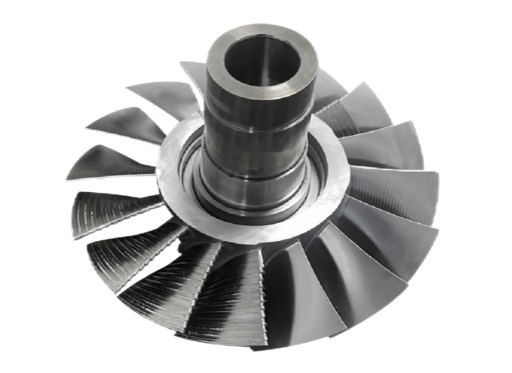
In the field of aero engines, the integral blade disk is the core hot end component, and its processing accuracy directly determines the aerodynamic performance of the engine. Recently, a new high-temperature alloy integral blade disk processing project undertaken by an aviation manufacturing company has attracted industry attention because it breaks through the limits of traditional processes.
Processing product characteristics
The blade disk is made of GH4169 high-temperature alloy, with a diameter of 238mm and an integral thin-walled structure. The difficulty of its processing lies in the design requirement of the chord-thickness ratio of 40:1 and the micron-level precision control requirements at the transition of the blade surface. According to the technical agreement, the surface roughness of the blade needs to be optimized from Ra 3.1μm to Ra 0.51μm, and the contour accuracy needs to be improved to 0.04mm.
Challenges of process upgrade
The traditional processing solutions face four major technical bottlenecks:
1) The vibration of thin-walled structure processing leads to surface vibration
2) The actual roughness is only Ra 0.93μm
3) There are obvious cutting marks on the blade edge transition R angle
4) The position tolerance of some blades is as high as 0.12mm
MID solution integrates five-axis linkage processing, ultrasonic vibration cutting and micro-lubrication technology through the independently developed ultrasonic green processing system. Its core innovations are:
• Ultrasonic vibration spindle achieves 20,000 high-frequency micro-impacts per minute
• Five-axis linkage accuracy is stable at 8μm/1000mm
• Green cutting system reduces cutting fluid consumption by 95%
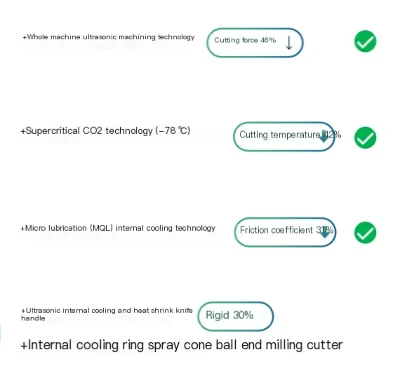
Processing data comparison
The implementation effect shows:
1) Surface roughness is reduced to Ra 0.408μm, a decrease of 56%
2) Contour accuracy is stably controlled in the range of 0.035-0.04mm
3) Polishing process time is shortened by 42%
4) Blade edge transition R angle smoothness is improved by 3 levels
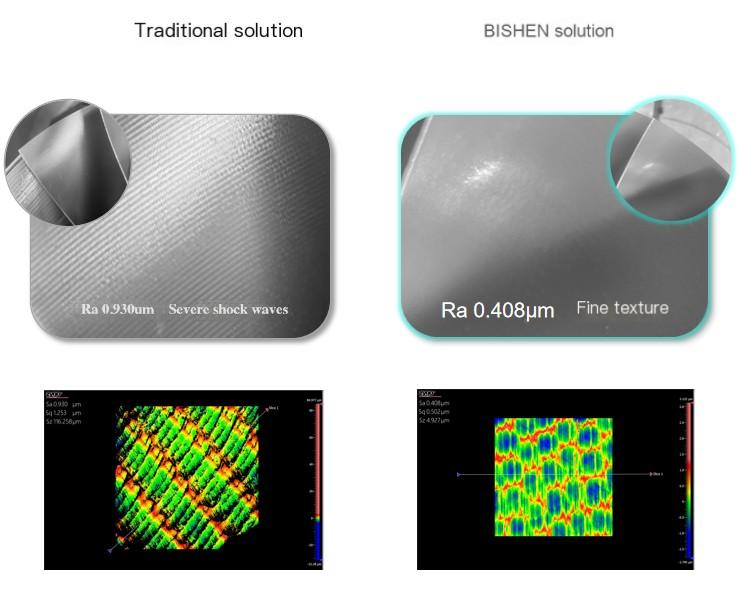
According to bench tests, the blade disk manufactured using the new process increases the overall efficiency of the engine by 4.3%-4.7%, and the annual fuel cost of a single engine is saved by 120,000 US dollars. This case has set a new process benchmark for the processing of key components of aircraft engines.


