



Powder metallurgy, as the name implies, is a processing method that uses metal powder as raw material, and is pressed and sintered to make various products. This is not a new process and technology, and can even be traced back to ancient Egypt. However, in today's pursuit of sustainable development and green development, it is in line with the development of the times and has been increasingly used. Today, let's take a look at this manufacturing method, which may provide a new option for everyone's parts manufacturing method.
PROCESS
Powder metallurgy is similar to forging or casting, but the difference is that its raw material is metal powder (commonly iron, steel, copper, etc.). The powdered raw materials are pressed at room temperature (heated in special cases) using complex molds. The size of the pressed workpiece is close to the finished product, but its mechanical properties are still unstable. In order to further strengthen it, it is then sintered at a temperature close to but slightly lower than the melting point of the metal used. At this time, the microstructure of the product will change, and a component with precise dimensions and high strength will be obtained.
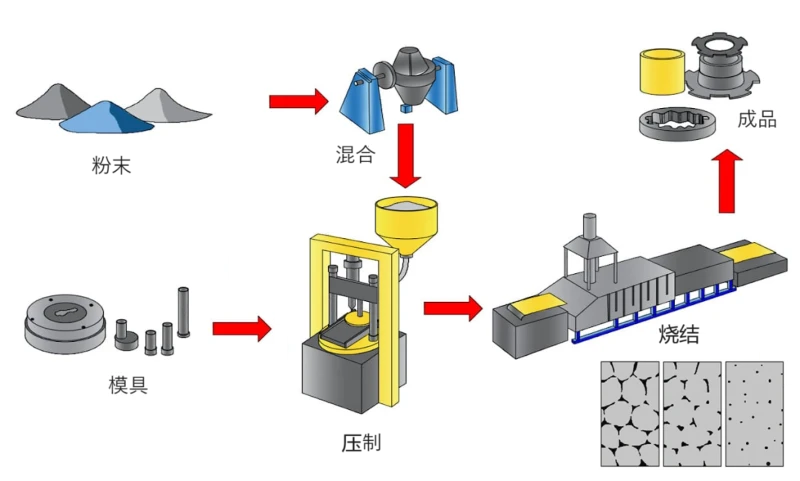
Generally speaking, the parts obtained by powder metallurgy can be used directly, but they can also be processed for secondary processing as needed, such as finishing, heat treatment, electroplating or coating, shot peening, etc., to enhance or improve the tolerance, density, strength, shape, corrosion resistance and other properties of the parts.
Advantages of Powder Metallurgy
Compared with other manufacturing technologies, powder metallurgy produces almost no material waste, the material utilization rate exceeds 97%, and it can directly form complex geometric shapes and maintain tight dimensional tolerance control in sintered products, which can reduce or even completely eliminate the processing operations in traditional manufacturing processes. This is why we call it green manufacturing technology.
In addition to the savings brought by these processes, powder metallurgy has its own uniqueness. It uses the advantage of its raw materials as powders to achieve some controls that are difficult or impossible to achieve in traditional processing, such as the ratio control of chemical composition combinations, the control of microstructure, and the control of porosity.
Let's use some specific product examples to enhance everyone's understanding.
1. Combine materials that cannot be dissolved together
Powder metallurgy allows the processing of material combinations that are usually regarded as incompatible in an intimate mixed form. Proven examples of such powder metallurgy applications include:
Friction materials for brake linings and clutch faces where a range of non-metallic materials
(used to impart wear resistance or control friction levels) are embedded in a copper or iron matrix.
Cemented carbides are often used for cutting tools, forming tools or abrasives. They include a hard phase bonded to a metal, a microstructure that can only be produced by liquid phase sintering at a temperature above the melting point of the binder. Tungsten carbide bonded to cobalt is the main example of this material, but other cemented carbides including a range of other carbides, nitrides, carbonitrides or oxides can also be used, and other metals besides cobalt can be used as binders (Ni, Ni-Cr, nickel cobalt, etc.).
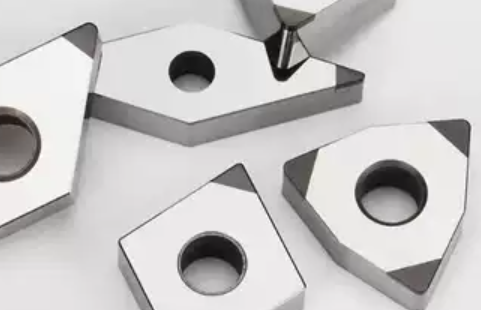
Diamond cutting tool materials where fine diamond grit is evenly dispersed in a metal matrix. Again, liquid phase sintering is used in the processing of these materials. Electrical contact materials such as copper/tungsten, silver/cadmium oxide.
2. Processing of materials with very high melting points
Powder metallurgy technology can process materials with very high melting points, including refractory metals such as tungsten, molybdenum and tantalum. Such metals are difficult to produce by melting and casting, and are generally very brittle in the cast state. The production of tungsten billets was one of the early applications of powder metallurgy, which was subsequently used to draw wires for incandescent lamps.
3. Products with controlled porosity
Powder metallurgy technology can produce products with controlled structural porosity. Sintered filter elements are an example of such an application. Another major example is oil-retaining or self-lubricating bearings, one of the oldest applications of powder metallurgy, in which the interconnected porosity in the sintered structure is used to contain the lubricating oil.
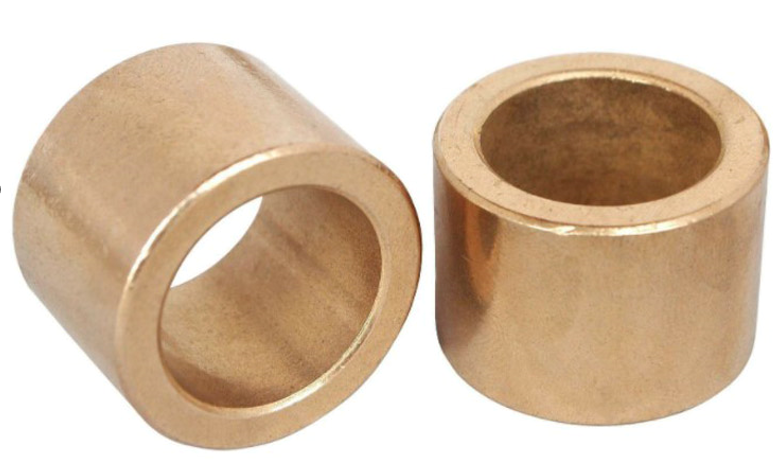
4. Products with superior properties
In certain specific applications, powder metallurgy processes can often produce superior properties through excellent control of the microstructure, as opposed to conventional casting or forging processes. Good examples of such applications are:
Magnetic materials
Almost all hard (permanent) magnets and about 30% of soft magnets are processed from powder feedstock.
High-speed steel
Powder metallurgy processed materials have a finer and more controlled microstructure than forged products, with higher toughness and cutting performance.
Nickel or cobalt-based high-temperature alloys
Nickel-based or cobalt-based superalloys are used in aerospace engine applications, where powder metallurgy processes can provide a composition range and microstructure control that cannot be achieved conventionally, thereby increasing operating temperatures and performance.
Limitations of Powder Metallurgy
Although powder metallurgy has various advantages, there are still some limitations in its application. The main points are as follows:
1. Part size and weight are limited:
Powder metallurgy requires a pressing process, which will use a press. Therefore, it is limited by the current press tonnage, and the size cannot be made very large, generally around 250mm at most. In addition, due to the limited fluidity of metal powder, it is still difficult to produce parts weighing more than 20kg using the powder metallurgy process.
2. Not suitable for impact and dynamic load applications
Since the density of powder metallurgy parts is usually low, their strength and toughness are not as good as forged or machined parts. The pores after powder compaction and sintering will also affect the mechanical properties of the material. This makes powder metallurgy parts less suitable for high stress and high strain applications such as impact and high dynamic loads.
3. Higher equipment and mold costs
The process of powder metallurgy determines that it must use special molds and equipment, and the cost is relatively high. It is not economical in small batch production, so powder metallurgy is usually suitable for large-scale production.(文章来源:iMechanics机械)


