



The breakage of tools and cutters is an important factor affecting the qualified rate of products. When taps, drills, etc. are broken in the workpiece, the traditional treatment methods such as manual slow knocking, smashing, gas welding and twisting out, or acid corrosion, flame cutting, etc., are often unsatisfactory. Next, the editor will introduce several more effective tips for dealing with broken tools.
DRIPPING LUBRICANT AND KNOCKING
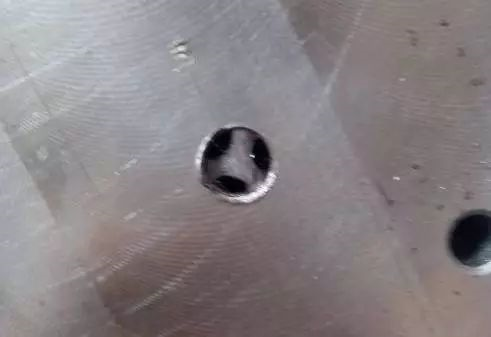
You can try to apply some lubricant to the fracture, and then use a pointed hairpin or chopper to gently knock in the opposite direction of the fracture surface, and clean up the iron filings from time to time (this is a common method in the workshop, but if the aperture of the threaded hole is too small or the broken tap is too long, it may not be applicable, but it is still worth a try).
WELDING HEXAGONAL NUT REVERSAL
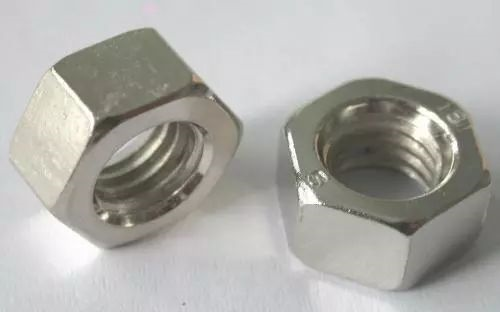
Another method is to weld a handle or hexagonal nut on the broken part of the tap, and then carefully rotate it in the opposite direction (this is originally an effective method, but the welding process is relatively cumbersome, and it may not be applicable for taps with smaller diameters).
TAP EXTRACTOR
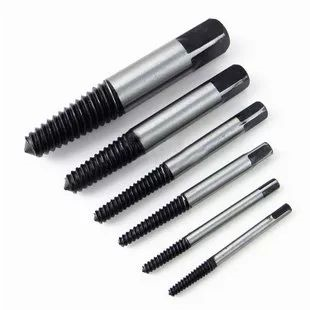
Use professional equipment - broken tap extractor. Its working principle is to connect the workpiece and the tap with positive and negative electrodes respectively, and inject electrolyte between them. Use electrolysis to make the workpiece discharge and corrode the tap, and then use tools such as needle-nosed pliers to assist in pulling it out. This method causes minimal damage to the inner hole of the workpiece.
STEEL ROD AGAINST THE CRACK
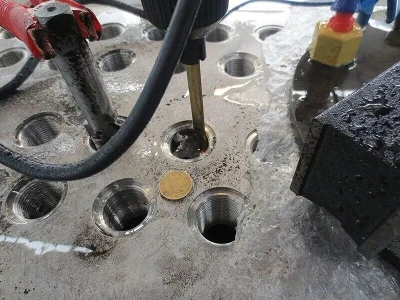
You can try to use a steel roller to support the crack of the tap, and then slowly tap it with a small hammer. Because the tap material is brittle, it will eventually be knocked into debris and discharged. Or a more direct method is to directly drill or bore the threaded hole where the broken tap is located, and then re-expand and tap (this method is relatively rough. If the tap diameter is too small, it may not be applicable, and if the diameter is too large, it is quite laborious to tap).
ElELECTRIC PULSE KNOCKING
Broken taps can be removed by using electric pulse technology, such as electric spark or wire cutting. If the hole is accidentally damaged during the processing, it can be repaired by expanding the hole and adding a wire thread insert (this method is simpler and faster, but it should be noted that the coaxiality problem may not be taken into account here unless the coaxiality of the threaded hole has a direct impact on the performance of the equipment).
REVERSE WRENCH
You can make a simple tool by yourself, insert it skillfully into the empty space of the chip groove of the broken tap, and then carefully wrench it in the opposite direction to remove it. Another way is to tighten two nuts on the broken tap with a square tenon, insert the number of steel wires matching the number of tap grooves into the empty groove between the broken tap and the nut, and then use a hinge lever to rotate the square tenon in the direction of withdrawal to smoothly pull out the broken tap.
The core concept of this method is to use the chip groove of the broken tap and make a wrench specifically for removing broken taps through steel wire (preferably steel needle). If tap breakage occurs frequently in the workshop, it would be a wise choice to make such a special tool wrench.
CONICAL TOOL PRYING
Prying with a conical tool that is harder than the broken object. (The disadvantage is that it is only suitable for brittle fractures, which can be broken by knocking and then gradually cleaned out; but it is difficult to work for fractures that are too deep or too small; and it is easy to damage the original hole.) If you encounter special circumstances, such as the head of the screw being broken due to excessive force, you need to adopt another coping strategy.
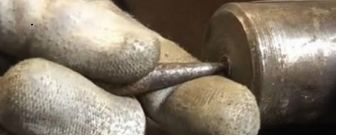
First use a positioning pin to make a positioning hole.
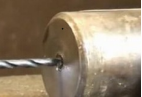
Then it is time to drill the hole. Choose a model that is smaller than the original bolt to avoid damaging the external thread inside when drilling.
The tap used must be left-handed. (Important tip: The right-handed tap rotates toward the inside of the bolt. If the direction is wrong, it will directly cause damage to the bolt.) After the drilling operation, the screw will be partially exposed outside the bolt. At this time, you need to use a left-handed tap carefully to slowly screw it out.
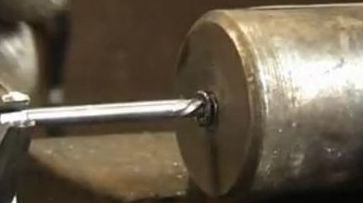
The ultimate goal is to successfully screw out the entire bolt, that is, the remaining screw part, while ensuring that the external thread part of the bolt remains intact.
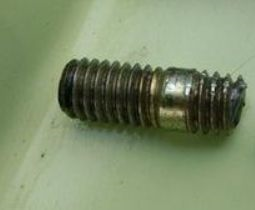
Although the broken part can be taken out in the end, this is ultimately only a remedy after the wire breaks during the processing process. A more ideal method is to prevent it in advance, minimize or even avoid the occurrence of wire breakage, which is the fundamental solution.(来源:UG学习堂小胥收徒)


