



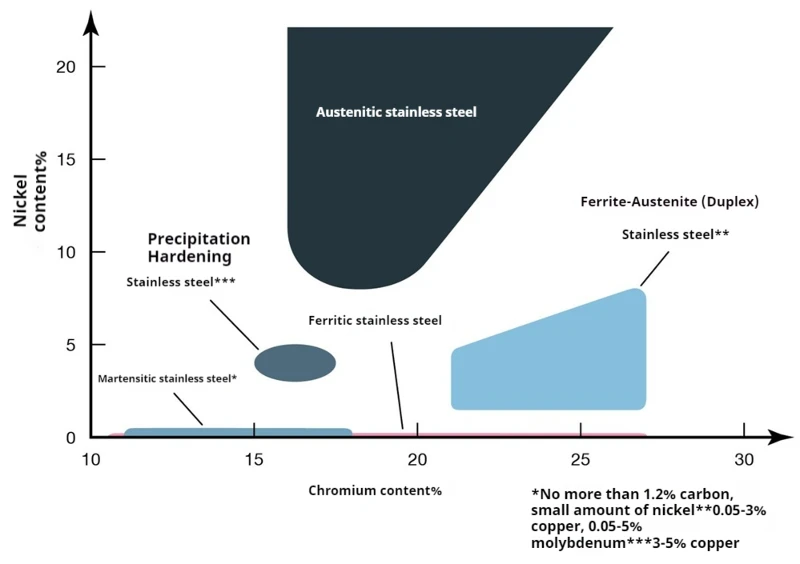
There are many types of stainless steel, such as ferritic stainless steel, austenitic stainless steel, martensitic stainless steel, duplex stainless steel, precipitation hardening stainless steel, etc., as shown in the figure below.
The reason why stainless steel can be ineffective is mainly because it contains no less than 12% chromium (Cr), which can be seen from the figure above. The chromium on the surface reacts with oxygen in the air to form a chromium oxide (Cr₂O₃) passivation film. This passivation film is very thin but dense, which can isolate the metal from the external medium and prevent chemical reactions, thereby protecting the metal from corrosion.
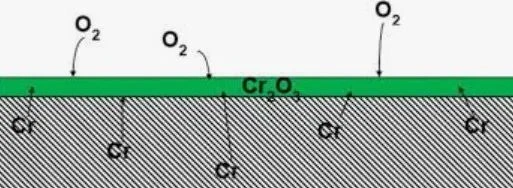
Even if the surface of the stainless steel is mechanically damaged or chemically eroded, the chromium oxide passivation film can self-repair. As long as there is enough oxygen, the chromium element on the surface of the stainless steel can continue to react with oxygen, repair the damaged passivation film, and restore its protective effect.
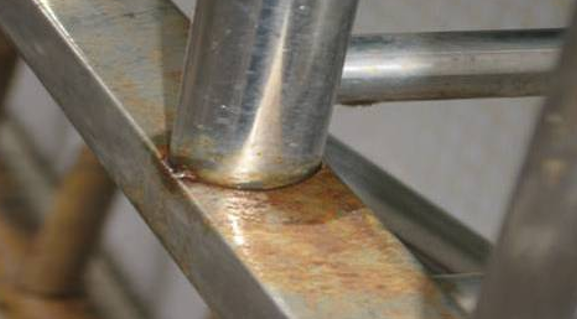
Under the protection of the chromium oxide passivation film, stainless steel can resist the erosion of most corrosive media such as acids, alkalis, and salts. However, in actual practice, people still sometimes see stainless steel rusting, as shown in the figure below. What's going on?
1. The quality of stainless steel is unqualified and the material composition does not meet the requirements. For example, the actual chromium content is less than 12%, or the content of elements such as nickel and molybdenum is insufficient, which cannot play a good anti-rust effect.
2. Used in an environment containing halogen ions (Cl⁻, Br⁻, I⁻, etc.), such as seawater, salt spray, chlorine-containing detergents, etc. These halogen ions can penetrate the passivation film, forming tiny corrosion pits and developing in depth.
3. Stainless steel is affected by high temperature and intergranular corrosion occurs. When stainless steel is heated at 427~816℃, such as after welding or heat treatment, chromium carbide (Cr₂₃C₆) will precipitate at the grain boundary, resulting in chromium depletion near the grain boundary (Cr content <12%), thereby losing the ability to form a passivation film.
4. Stress cracking corrosion. When stainless steel is subjected to tensile stress, if the factors in the above 2nd and 3rd items exist, the stress will accelerate the penetration of the corrosive medium and cause cracks to propagate along the grain boundary or through the grain.
5. The surface is contaminated or damaged. For example, when carbon steel tools come into contact with stainless steel surfaces, residual iron filings can cause galvanic corrosion due to the different potentials between the metals. Scratches, welding spatter, etc. can damage the passivation film, causing corrosion starting points to form before the passivation film is formed. Oil stains on the surface of stainless steel can hinder the formation of the passivation film. Dust and impurities can absorb moisture and corrosive substances, thereby accelerating local corrosion.(来源:iMechanics机械)


