



Today I will use the simplest language to talk to you about how to install round nuts.
Round nuts, round nuts that comply with GB/T812 are shown in the figure below. One side has a relatively large 30° chamfer, which is mainly used for axial fixation of parts. So which side of this round nut is close to the side of the compressed part when it is actually installed?
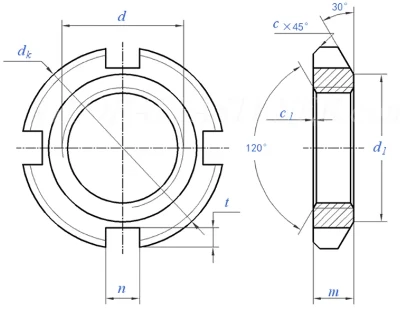
Generally speaking, when using round nuts, in order to prevent loosening, they will be used with stop washers. There are also many kinds of stop washers. The stop washers that comply with the national standard GB/T858 are shown in the figure below. As you can see, the washer has many tabs and it also has an inclination angle of 65°. And if you check the standard comparison figure D1 size and the d1 size of the round nut in the figure above, you will find that they are the same.
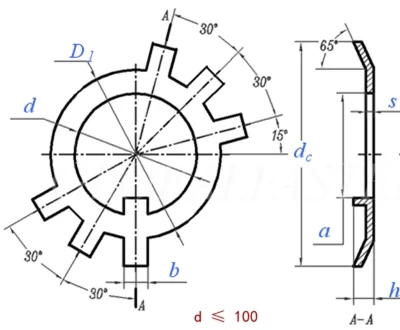
I believe you have found the clue. By the way, the side with a large chamfer of 30° on the round nut is used with this stop washer. Therefore, when they are used together, the side with a large chamfer faces the compressed part. As shown in the figure below.
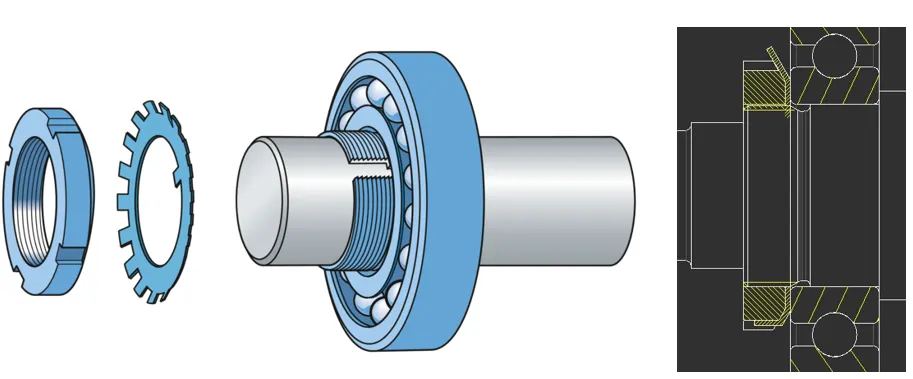
Sometimes we may not use a locking washer, for example, we can use a double round nut to prevent loosening. If there is no requirement for anti-loosening, sometimes we may just use one round nut to tighten. Does that mean the installation direction is not that important? Generally speaking, there are two factors to consider. One is that the standard for the large chamfer side of the round nut has verticality regulations, but the other side does not; the other is that for the bearing parts in the above picture, it is generally best to keep the diameter of the parts close to the bearing not higher than the inner ring of the bearing, so it is better to have the side with the large chamfer facing the pressed part. If there are no considerations and restrictions in this regard, you can do whatever you want.(来源:iMechanics机械)


