



In the field of modern precision machinery manufacturing, the center hole, as the basic positioning reference for CNC programming, has always been a key link in the workpiece clamping strategy. Even though the current GB/T145 standard has been used for decades, with the popularization of five-axis linkage machining centers, its coordinated optimization with CNC technology is still worth in-depth discussion.
Three core functions of the center hole in CNC machining
The first is positioning:through the center holes at both ends to establish a unified and firm center line, so that other features can be processed later and the accuracy can be maintained.
The second is to facilitate clamping, to bear the weight and cutting force of the workpiece.
The third is to connect other parts through the threaded center hole, or to facilitate lifting.
Next, let's look at the common center hole types: GB/T145 standard stipulates four types: A, B, C and R. They are shown in the following figure:
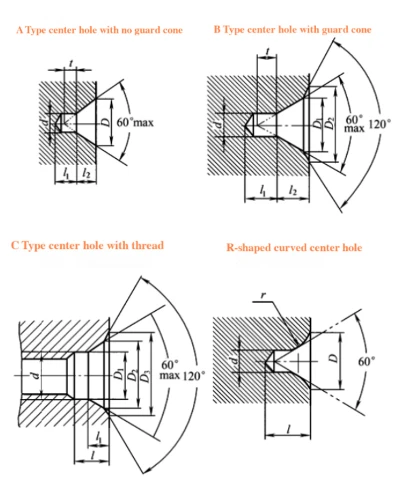
Mainstream center hole types and CNC process compatibility
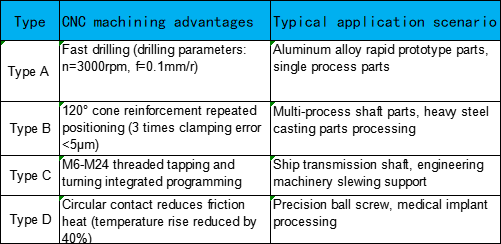
Special application of German standard DIN332 center hole in CNC field
German machine tool users should pay special attention: DIN332-C type adopts 60° main cone angle + 30° auxiliary cone angle design, which perfectly matches the HSK chuck system of Hardinge CNC lathe. Its D-type threaded hole supports rapid switching of modular fixtures, which is particularly suitable for flexible production line requirements such as automotive differential housing.
CNC process parameter decision matrix
A comprehensive evaluation is required when selecting the center hole specification:
Calculation of the minimum diameter of the shaft end and the interference area of the tool holder
Centrifugal force compensation caused by workpiece quality (formula: F=mω²r)
Cutting force simulation analysis (Mastercam cutting force module is recommended)
Benchmark uniformity of cumulative errors in multiple processes
For example, when processing wind power spindles (material 34CrNiMo6), it is preferred to use B-type center holes with PVD coated carbide tips, and use constant linear speed cutting (Vc=180m/min) in the rough turning stage, and switch to CBN tools for mirror turning during fine machining.
Frontier technology integration
The current intelligent CNC system has achieved:
Visual inspection automatically compensates for center hole wear (CCD accuracy ±2μm)
Prediction of clamping deformation based on digital twins
Liquid nitrogen cooling process for center holes during titanium alloy parts processing
These innovations deeply integrate traditional standards with CNC processing, and continue to promote breakthroughs in precision manufacturing.(文章来源:iMechanics机械)


