



Today, let's talk about a situation that you may often encounter. That is, can the bolts be disassembled and reused? For example, can the pre-tightened bolts be used again and tightened according to regulations after being disassembled? I believe that many manufacturers have disassembled and reused them. What is the explanation? Let's take a look together.
A basic point of view is: when the maximum tensile force acting on the bolt does not cause permanent deformation of the bolt, that is, when the maximum stress does not exceed the yield strength of the bolt material, the bolt can be reused.
Here are a few key points that you need to pay attention to:
1. How to simply judge whether the bolt has been permanently deformed?
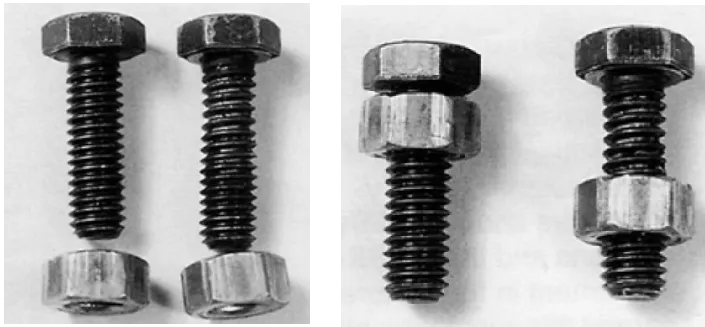
After the bolt has been permanently deformed, the length will be longer than the original length. As shown in the comparison of the two bolts on the left side of the above picture. A relatively simple (but not very accurate) method is to find a new nut and tighten it on the used bolt. If the tightening process is relatively smooth (no jamming) over the entire thread length, there is no problem. Otherwise, if the rotation is not smooth, it means that the bolt has been deformed.
2. Will the tightening torque change when it is used again?
If we control the preload or clamping force of the bolt by tightening torque, then the effect of repeated tightening on the torque-tension relationship needs to be considered when the bolt is reused. We know that most of the tightening torque is used to overcome the friction between the thread pair and the joint surface, and only a small part is converted into the most useful clamping force for the threaded connection.
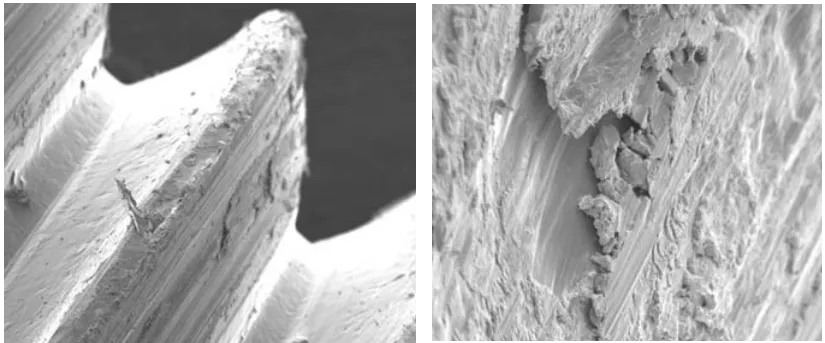
After the fastener is tightened, the surface roughness and irregularities that may have existed will be flattened under the action of pressure, increasing the contact area. When the fastener is tightened multiple times, the thread pair and the joint surface slide against each other under high pressure, which will also cause a certain degree of mating surface wear (as shown in the figure below), which will increase the friction coefficient. The combined effect of the two makes the bolt have greater friction when tightened multiple times, and less effective part of the tightening torque converted into preload.
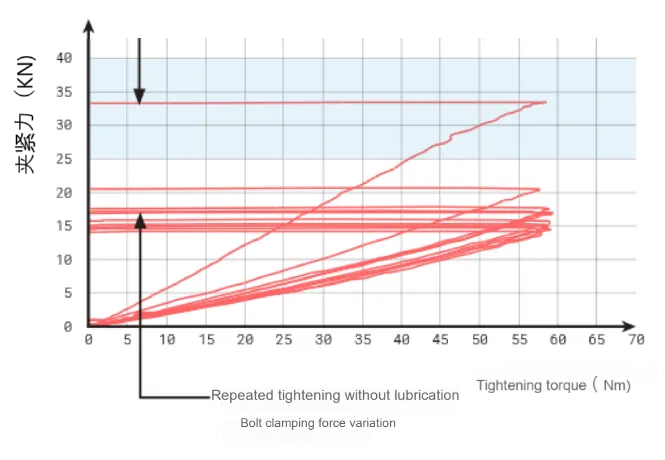
Therefore, when tightening twice or multiple times, it is necessary to use a torque greater than the original tightening torque for tightening (it has been calculated that it can be up to 2 times). If you want to maintain stability, you need to use other tightening methods that precisely control the clamping force or use proven lubricants (such as molybdenum disulfide coating or grease, etc.) every time you tighten to reduce the impact of friction and wear.
3. Can old and new bolts and nuts be mixed?
Used bolts should not be used in combination with new nuts. Used nuts should not be paired with new bolts. Due to the differences between components, under the influence of tension and environment, the used bolt threads may have some invisible changes that make them not work well with new threads. Mixing may cause uneven or unstable connections.
Finally, for important applications or occasions with high safety requirements, it is not recommended to reuse bolts because there are greater unknowns and risks. It is usually difficult to know whether the bolts are over-tensioned and deformed. If you have any concerns about the condition of the bolts, it is best to discard them and replace them with new ones. After all, bolts are not valuable, and equipment damage or accidents caused by reusing bolts are not worth the loss.(来源:iMechanics机械)


