



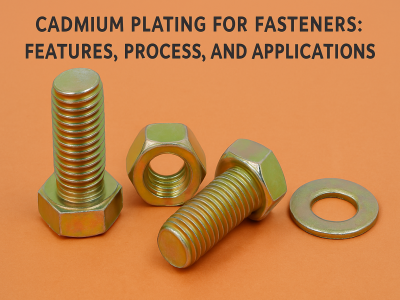
Cadmium plating for fasteners is a surface treatment technology widely used in aerospace, military, marine, and highly corrosive environments. Cadmium plating provides excellent corrosion resistance and, in certain environments, outperforms zinc plating. Below is a detailed introduction:
1. What is Cadmium Plating for Fasteners?
Cadmium plating involves coating a layer of cadmium metal (Cd) onto the surface of fasteners (bolts, nuts, screws, etc.) to enhance their corrosion resistance, friction resistance, and conductivity. In particular, cadmium-plated fasteners effectively resist salt spray corrosion and perform well in high-temperature and high-humidity environments.
2. Advantages of Cadmium Plating
Excellent Corrosion Resistance:
Cadmium plating offers better resistance to corrosion than zinc plating in marine, humid, or high-salt environments.
Forms a cadmium oxide protective layer, effectively preventing substrate rust.
Self-Lubrication:
Low friction coefficient, suitable for fasteners requiring precise torque control.
Reduces galling, seizure, and wear issues.
Superior Electrical Conductivity:
Widely used in aerospace and electronics industries to provide stable electrical contact.
High-Temperature Resistance:
Maintains stable protective effects below 235°C, suitable for high-temperature environments such as aircraft engines.
Weldability:
Easier to weld compared to zinc plating, without affecting welding quality.
3. Cadmium Plating Process
Cadmium plating is typically performed using an electroplating process, which includes the following steps:
(1) Surface Preparation
Degreasing and Cleaning: Removes oil, lubricants, and contaminants from the fastener surface.
Acid Pickling: Uses diluted acid to remove surface oxides and improve adhesion of the plating layer.
Rinsing: Ensures a clean surface without acid residues.
(2) Cadmium Electroplating
Electrolyte: Cadmium plating generally uses cyanide cadmium solutions or non-cyanide plating solutions.
Workpiece as Cathode: Under electrical current, cadmium ions are deposited from the solution onto the fastener surface, forming a uniform plating layer.
(3) Post-Treatment
Passivation Treatment (Chromate Conversion Coating):
Enhances corrosion resistance and prevents cadmium oxidation.
Common passivation colors: clear, yellow, olive green (military grade).
Sealing Treatment:
Further enhances corrosion resistance, especially for aerospace applications.
Hydrogen Embrittlement Relief Baking:
Prevents high-strength steel fasteners from fracturing due to hydrogen embrittlement.
Typical baking temperature: 190°C - 220°C, duration: 3 - 24 hours (depending on fastener grade).
4. Disadvantages of Cadmium Plating
Environmental and Health Concerns:
Cadmium is a toxic metal that pollutes the environment and is harmful to humans (especially plating solutions and cadmium fumes).
Strictly regulated by environmental laws such as the EU RoHS and REACH, leading to its gradual replacement by eco-friendly alternatives (e.g., zinc-nickel alloy plating, aluminum coatings).
High Cost:
Cadmium materials are expensive, and the plating process requires strict control, making it costlier than zinc plating.
Regulatory Restrictions:
Due to cadmium's toxicity, some countries and regions have restricted the use of cadmium-plated fasteners.
5. Applications of Cadmium Plating
Due to its superior performance, cadmium-plated fasteners are mainly used in the following industries:
Aerospace: Aircraft structural components, engine fasteners, electrical connectors, etc.
Military Equipment: Critical parts in tanks, armored vehicles, and weapons systems.
Marine Industry: Corrosion-resistant bolts for ships, submarines, and offshore platforms.
Electronics Industry: Fasteners or electrical contacts requiring high conductivity.
Nuclear Energy Equipment: Used in high-temperature and high-radiation environments.
6. Eco-Friendly Alternatives to Cadmium Plating
Due to environmental regulations, many industries are seeking alternatives to cadmium plating, including:
Zinc-Nickel Alloy Plating (Zn-Ni): Offers corrosion resistance similar to cadmium plating, eco-friendly, and cost-effective.
Aluminum Coatings (e.g., AlumiPlate®): Used in aerospace and military applications, offering excellent corrosion resistance and conductivity.
Trivalent Chromium Passivated Zinc Plating: An eco-friendly option for general industrial applications, though slightly less protective than cadmium.
Thermal Sprayed Aluminum Alloy: Suitable for marine and high-temperature environments, with good corrosion resistance.
7. Conclusion
Cadmium-plated fasteners remain essential in aerospace, military, and marine industries due to their outstanding corrosion resistance, self-lubrication, conductivity, and high-temperature performance. However, due to environmental concerns, many countries are restricting its use and promoting eco-friendly alternatives.


