



Bolts are the most commonly used fasteners, and they encounter the most failures. For bolts, do you know where the most common failure location is?
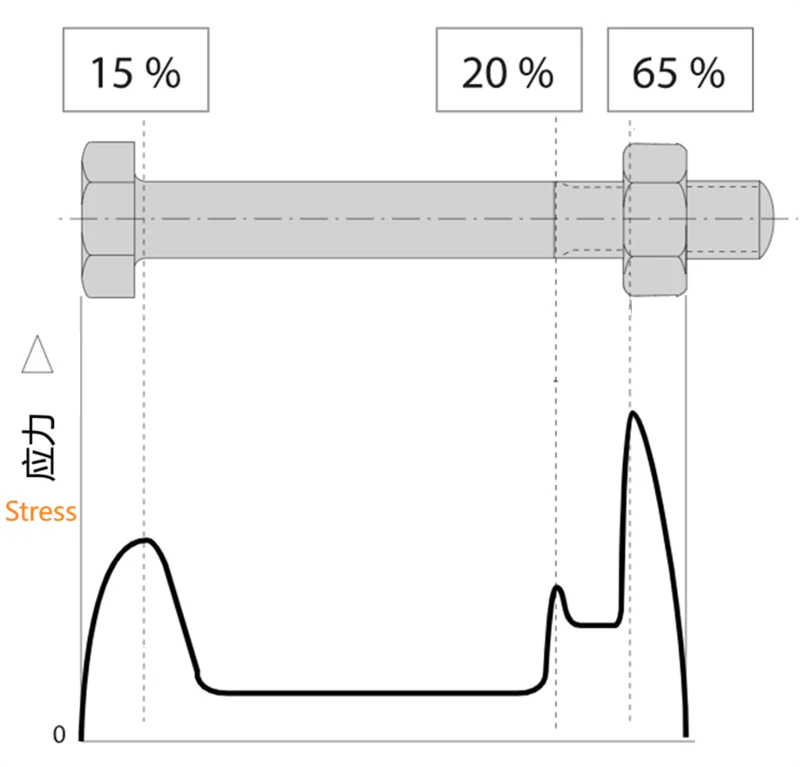
As shown in the figure below, there are actually three main locations: ① The root of the first thread where the bolt and nut match, with a failure rate of 65%, ② The transition zone between the thread and the polished rod, with a failure rate of 20%, and ③ The transition between the bolt head and the screw rod, with a failure rate of 15%. These three locations are also the high points of the bolt stress distribution.
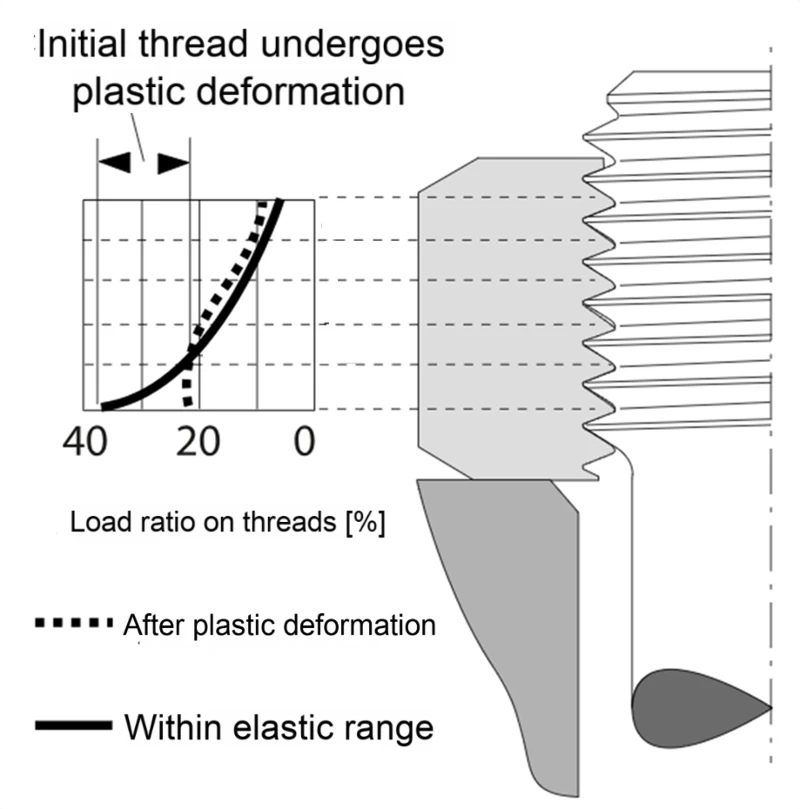
Among them, the failure of the first position, that is, the root of the first thread where the bolt and the nut match, is usually caused by uneven thread load distribution, and the first circle of the thread bears the largest load (subsequent circles decrease), as shown in the figure below. The stress concentration factor here can reach 2-8, and it is easy to initiate cracks and expand, especially under alternating loads, fatigue fracture is more likely to occur.
The second position, the failure of the transition zone between the thread and the polished rod is mainly caused by stress concentration caused by geometric mutation. If the transition zone has poor roughness, processing defects or material defects, the fatigue strength will be further reduced.
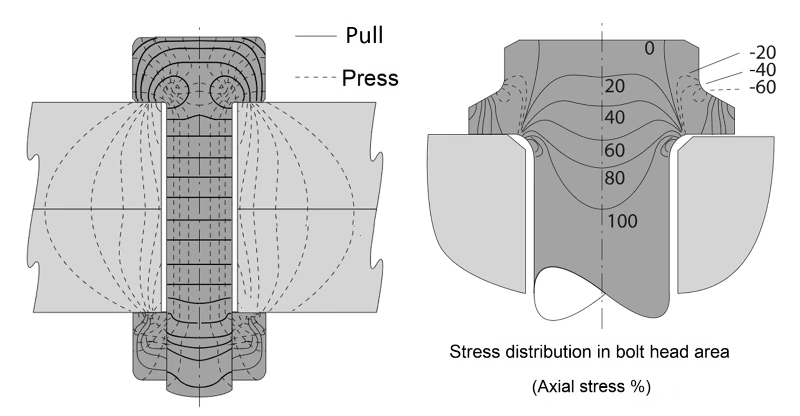
The third position, the transition between the bolt head and the screw, is usually caused by stress concentration due to the small radius of the transition fillet of the head and the screw (usually requiring R ≥ 0.15d, d is the bolt diameter) or processing defects (such as interruption of the cold heading flow line). Moreover, this place is subject to the combined stress of bending and stretching, and is also more prone to fracture.(来源:iMechanics机械)


