Processed products
Material: Nickel-based high-temperature alloy Processing features: φ0.5/0.6/0.7mm special-shaped air film inclined hole, aperture tolerance ±0.005mm, spatial position accuracy ≤0.03mm
Processing background and industry pain points
A. Industry status
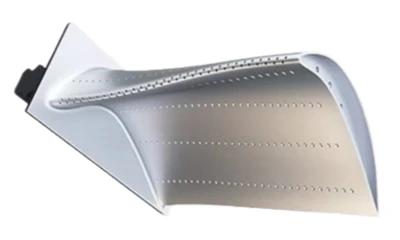
In the field of aero-engine blade manufacturing, air film hole processing is a core process that directly affects turbine efficiency and life. The current mainstream laser processing, EDM and other special processes generally have the problem of residual remelting layer - microcracks and resolidification layers are formed on the surface of the material under high temperature, causing the blade to easily fail under extreme working conditions due to fatigue. According to industry statistics, the engine failure rate caused by remelting layer defects accounts for as high as 32%
B. Pain points of traditional processes
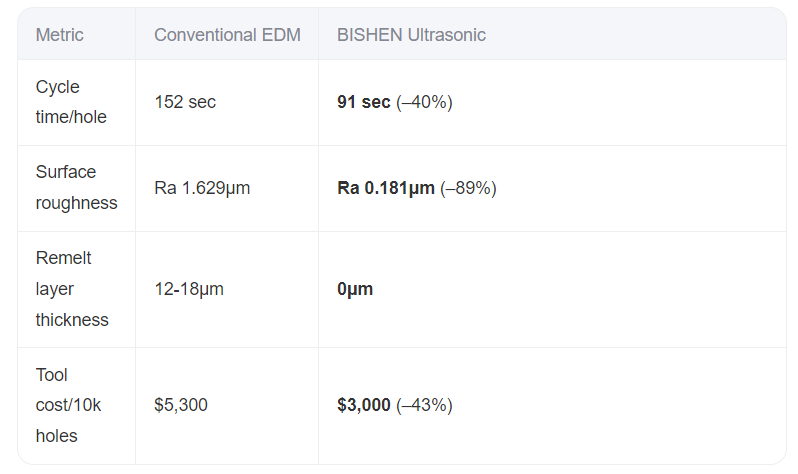
Remelting layer residue: EDM processing of a single hole produces a 10-15μm remelting layer, which requires secondary chemical cleaning, increasing costs
Low processing efficiency: Single hole processing takes 150 seconds, and the pass rate of complex surface position is only 78%
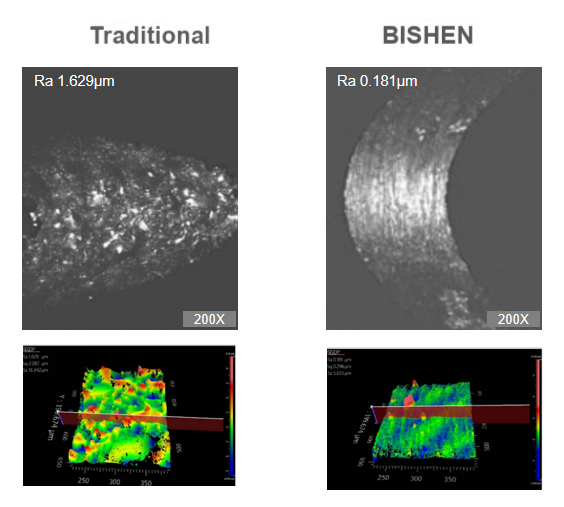
Poor surface roughness: Ra value is generally >1.6μm, affecting the uniformity of cooling air flow
MID Solutions: Five-axis linkage ultrasonic machining system
In response to the difficulty of high-temperature alloy air film hole processing, MID has developed a multi-modal composite machining solution:
Ultrasonic auxiliary spindle system: 40kHz high-frequency vibration cutting, reducing 65% cutting resistance
Supercritical CO2 cooling module: -78℃ low-temperature jet synchronously removes cutting heat
Nano-coated micro-diameter tool: 0.3mm diameter tool life is increased to 800 holes/blade
Five-axis linkage positioning technology: 0.002° rotation accuracy ensures complex angle hole position
Process effect comparison