



In order to enhance the performance of aluminum alloys, it is usually necessary to strengthen the aluminum alloys. There are currently two main methods: strain hardening and heat treatment strengthening. Among them, heat treatment strengthening is commonly used for copper alloy 2XXX, silicon magnesium 6XXX, zinc alloy 7XXX and other elements 8XXX series aluminum alloys; strain hardening is usually used for pure aluminum 1XXX, manganese alloy 3XXX, magnesium alloy 5XXX series aluminum alloys. Silicon alloy 4XXX series aluminum alloys can use both strengthening methods.
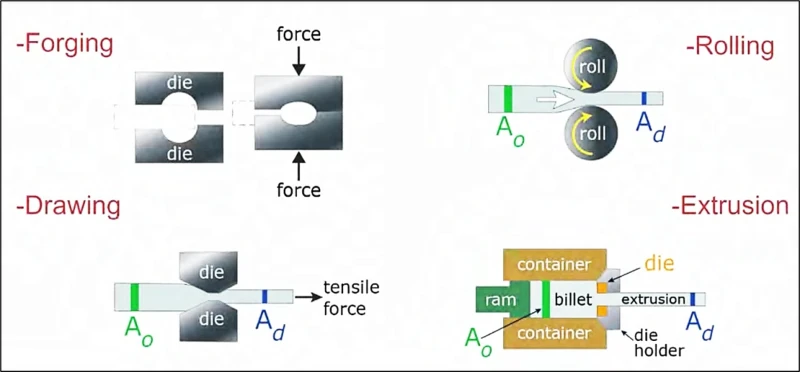
Strain hardening (Strain Hardened): Introducing dislocations through plastic deformation (such as stretching, rolling, forging), hindering crystal slip, and enhancing alloy strength. As shown in the figure below.
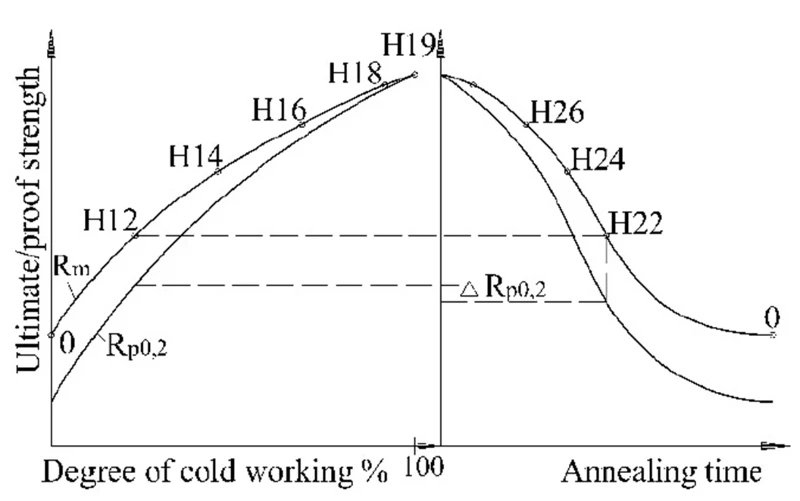
Strain hardened aluminum alloys often have a suffix of H+number after their code, such as 5052-H32, which means the following:
H1x = strain hardening only.
H2x = strain hardening and partial annealing.
H3x = strain hardening and stabilization (to ensure that mechanical properties do not change over time).
H4x = strain hardening and painting.
The second number shown as x above indicates the degree of cold work hardening. 2 = One quarter hard; 4 = One half hard; 6 = Three quarters hard; 8 = Completely hard; 9 = Superhard. The higher the value, the higher the strength but the lower the plasticity.
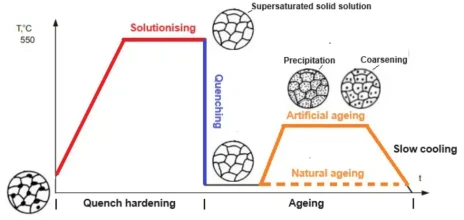
Thermal Treatment: The alloy elements are formed into strengthening phases through solution treatment and aging treatment, thereby improving the strength, as shown in the figure below.
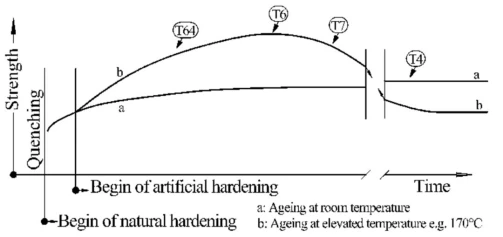
Thermal treatment strengthened aluminum alloys usually have a suffix of T+number after their code, such as 6061-T6, and the meanings of the different numbers are as follows:
T1: Natural cooling after high temperature forming process, natural aging.
T2: Natural cooling after high temperature forming process, cold working, natural aging.
T3: Cold working after solution heat treatment, natural aging.
T4: Natural aging after solution heat treatment.
T5: Natural cooling after high temperature forming process, artificial aging.
T6: Artificial aging after solution heat treatment.
T7: Over-aging after solution heat treatment (improved corrosion resistance).
T8: Cold working after solution heat treatment, artificial aging.
T9: Artificial aging after solution heat treatment, and then cold working.
T10: Natural cooling after high temperature forming process, cold working, and then artificial aging.
Strain hardening is usually used for aluminum alloy products that do not require high shape and dimensional accuracy, and have high strength requirements but low toughness requirements. Because it is easy to process and form and has low cost, it can be used for some unimportant structural parts, support parts, etc. Heat treatment strengthening is suitable for fields with high requirements on the performance of aluminum alloy materials, such as key components in aerospace, automobile and other fields, which are usually required to have excellent comprehensive properties such as high strength, high toughness, good corrosion resistance and fatigue resistance.
Back to our topic, T6, that is, artificial aging after solution heat treatment. As can be seen from the previous figure, T6 can obtain relatively good strength indicators while ensuring its comprehensive performance, which is why it has been widely used. (文章来源:微信公众号- iMechanics机械)


