



In precision metal machining, many factories face the same problem:
The first 20 parts are within tolerance, but from the 21st part onward, accuracy drifts and surface roughness becomes inconsistent.
Meanwhile, some factories maintain the same precision and surface quality from the first to the last part.
The difference is rarely in the equipment-it lies in tool life management and cutting condition control.
When reviewing their supply chain, European and U.S. customers pay close attention to this. They expect suppliers not only to achieve ±0.01 mm CNC machining tolerance, but also to maintain consistency and stability throughout long production runs.
The Practical Problem of Tool Wear
During machining, tool wear is inevitable. Without scientific monitoring, issues quickly accumulate:
Dimensional accuracy declines → tolerances exceed ±0.01 mm, parts no longer fit properly;
Surface roughness worsens → Ra value exceeds design limits, especially critical in aerospace machining and medical components;
Overcutting or burning → directly increases scrap rate;
Unexpected tool breakage → causes downtime, scrapped parts, and interrupted production flow.
In some domestic factories, I often see operators relying on "experience-based tool changes." This may be acceptable for single prototypes, but in batch production it is essentially uncontrollable. That's why Western customers prefer suppliers with systematic tool wear monitoring and tool life management in place.
Cutting Conditions and Their Impact on Tool Life
From practice, we know that cutting speed, feed rate, and depth of cut are the three main factors that affect tool life:
Cutting speed too high → accelerates wear, dramatically shortens tool life;
Feed rate too large → increases cutting forces, leading to chipping or tool breakage;
Cutting depth too deep → overloads the tool, causes vibration, and worsens surface roughness.
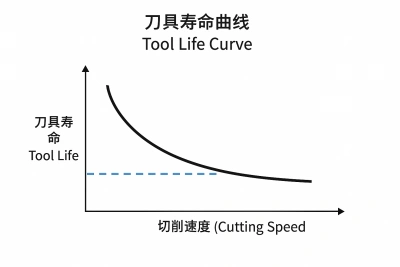
In European and U.S. factories, these parameters are recorded and analyzed to establish tool life curves.
For example: one carbide end mill lasts ~60 minutes at the recommended speed of 180 m/min. Increasing the speed to 220 m/min shortens tool life to just 25 minutes, while scrap rate rises by 8%.
This demonstrates the value of cutting speed optimization-finding the balance between accuracy and productivity.
The Role of Cooling and Lubrication
Beyond cutting parameters, coolant plays a critical role.
Proper cooling significantly reduces tool wear, prevents built-up edge and thermal deformation, and improves surface finish.
For difficult-to-machine materials such as titanium alloys and stainless steels, effective cooling and lubrication strategies are often the difference between success and failure.
Real-World Results: Lower Scrap Rate and Higher Efficiency
In our machining projects, we have built a tool life database combined with standardized cutting parameters, making production more predictable and controllable. The results are clear:
Lower scrap rate → higher yield in batch machining;
Stable surface roughness → Ra values consistently within customer requirements;
Improved tool utilization → fewer unnecessary tool changes, lower costs;
Higher overall efficiency → predictable cycle times and shorter lead times.
Conclusion
In precision CNC machining, tools are not just consumables-they directly determine dimensional accuracy, surface finish, and production efficiency.
Western customers emphasize scientific control of tool wear and cutting conditions because it directly impacts supply chain stability and part reliability.
Our approach can be summarized as:
Record → Analyze → Control → Optimize
This is the scientific way to manage tool wear and achieve precision CNC parts manufacturing at scale.


