

In the field of precision manufacturing, the combination of stainless steel and CNC processing technology is the "golden combination" of modern industry. From aerospace fasteners to medical-grade surgical instruments, stainless steel has become the preferred material for high-end parts manufacturing due to its excellent corrosion resistance, mechanical strength and hygienic properties. CNC processing technology has successfully overcome industry problems such as stainless steel material hardening and tool loss through five-axis linkage cutting and micron-level precision control.Today ,we talk about the codes of the most common 304 and 316 stainless steels meaning.
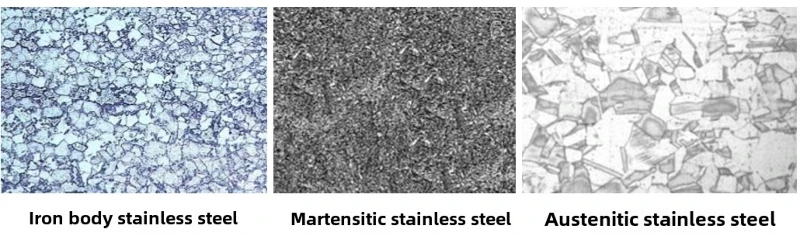
The main types of stainless steel are: austenitic stainless steel, ferritic stainless steel, duplex stainless steel (duplex usually refers to: austenite-ferrite two phases), martensitic and precipitation hardening stainless steel. Among them, austenitic stainless steel is the most widely used, accounting for more than 2/3 of the total amount of stainless steel produced in the world. This is because compared with other types of stainless steel, it has the characteristics of corrosion resistance, good ductility, high and low temperature resistance and good weldability, and is usually non-magnetic.
What do the codes of the most common 304 and 316 stainless steels mean?
Before understanding their meaning, it is necessary to understand their origin. In fact, this three-digit name originated from the American Iron and Steel Institute (AISI), which published these numbers in its "Steel Products Handbook" in 1974. The material number can be used to understand the type of different stainless steel materials, and also provides important information about their chemical composition, physical properties and scope of application. Afterwards, these grade numbering systems were widely used in the United States, where they originated, and were recognized by most stainless steel specification setters and users. Then they were widely used in other countries. For example, stainless steel in Japan also uses the AISI name, but with the letters SUS (steel use stainless) in front, such as SUS 304.
Later, the introduction of the "Uniform Numbering System" jointly formulated by ASTM (American Society for Testing and Materials) and SAE (American Society of Automotive Engineers) made the AISI grade classification more specific, but the numbering used the initial letter S + five-digit identification, such as UNS S30400 for 304, and UNS S30403 for 304L.
Europe has another system, following the EN standard formulated by the European Committee for Standardization (CEN), such as EN 1.4301 for 304 stainless steel. Finally, the ISO standard took into account the differences between the two major factions in Europe and the United States, and combined the two. For example, the material number of 304 stainless steel is: 4301-304-00-I, with the European number in the front and the American number in the middle.
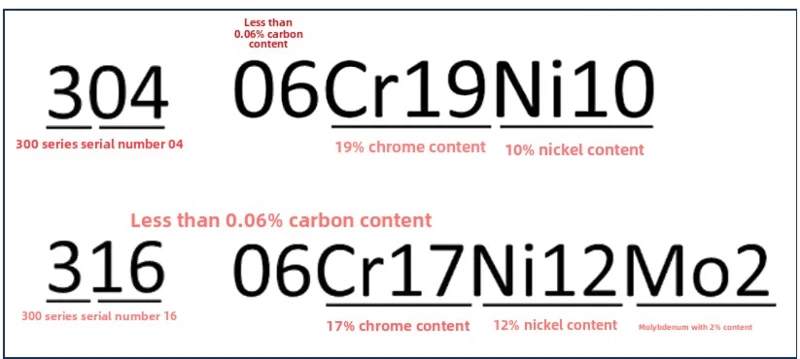
Let's go back to the meaning of the code. Numbers starting with "2" and "3" usually represent austenitic stainless steel, while martensitic and ferritic stainless steel usually start with 4. Therefore, when we see the "3" at the beginning of 304 and 316, we know that they are both austenitic stainless steel. However, the two digits after "3" have no special meaning, they are just the serial numbers of different materials. This is why we have been mentioning "numbers" instead of "grades" in the previous section. If you want to understand the specific chemical composition, you have to look at the grade. For example, the corresponding grade of 304 stainless steel in the ISO standard is X5CrNi18-10. In China, according to the national standard (GB/T 20878), the grade of 304 stainless steel is 06Cr19Ni10.(来源:iMechanics机械)