



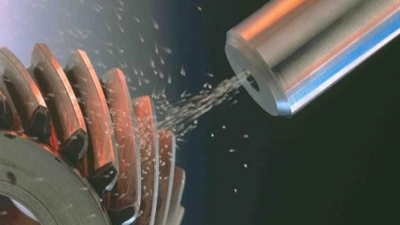
Shot peening is a widely used surface treatment technique for enhancing the performance of precision components. The basic principle involves bombarding a component surface with countless high-hardness, spherical media at high velocity under controlled conditions, causing localized plastic deformation. Though similar to processes like sandblasting and shot blasting, which differ in media and parameters, shot peening follows a unique cold working mechanism. This article focuses on shot peening as a representative process.
How Does Shot Peening Alter a Component's Surface?
During shot peening, a large number of high-speed media strike the surface, forming tiny indentations and inducing plastic deformation in the surface layer. Unless the original surface roughness is relatively high (Ra > 6.3 μm), the process typically increases surface roughness.
This raises a common contradiction: increased roughness often correlates with reduced fatigue strength, as seen in fatigue life calculations that include surface roughness correction factors.
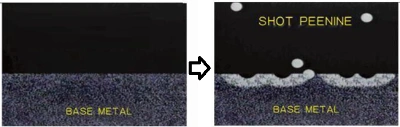
On the other hand, shot peening is also a proven method for improving fatigue strength, even without altering the material or part geometry. How can both of these statements be true?
The Two Reinforcement Mechanisms: Stress-Based and Structural
The apparent contradiction is resolved by understanding the dual strengthening mechanisms that shot peening offers:
Residual Compressive Stress Reinforcement
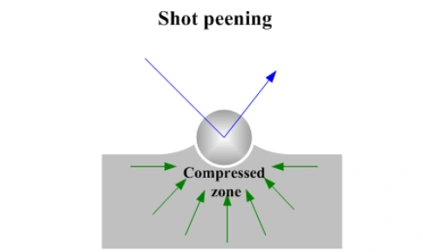
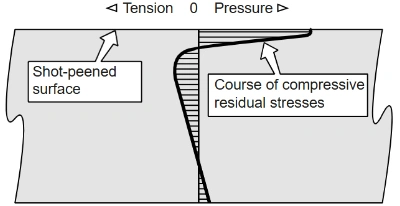
When the peening media impacts the surface, the outer layer undergoes plastic deformation, while the inner layer remains elastic. After impact, the plastically deformed surface is constrained by the underlying elastic layer, resulting in a stable residual compressive stress field.
This compressive stress counteracts the tensile component of cyclic loads, delaying or suppressing the initiation and growth of fatigue cracks.
This effect is particularly beneficial when pre-existing microcracks or defects exist, as the compressive stress helps "close" those cracks, significantly lowering the risk of fatigue failure.
Microstructural Refinement
The high-density impacts also lead to substantial microstructural changes in the material:
Surface grain refinement and increased dislocation density
Formation of subgrain structures
In materials like austenitic steels, martensitic phase transformation can occur, adding transformation-induced strengthening
Impeded slip within the crystal lattice, limiting deformation between the hardened surface and the internal matrix
These transformations enhance surface hardness, wear resistance, and delay fatigue crack formation.
Is Shot Peening Always Effective? Only With Proper Process Design
While shot peening can improve fatigue strength by 20% to 60%, its effectiveness hinges on carefully controlled process parameters. Factors that influence the outcome include:
Media type, size, shape
Peening pressure and velocity
Impact angle and direction
Coverage rate and repetition cycles
Initial surface condition of the component
In other words, shot peening is not as simple as it looks. Poorly controlled parameters may result in premature damage rather than improvement.
Conclusion
Shot peening introduces beneficial residual compressive stresses and microstructural enhancements that significantly extend component fatigue life and wear resistance.
Even though it increases surface roughness, the overall benefits often outweigh the drawbacks-if the process is properly optimized. For industries such as aerospace, automotive, and high-performance machinery, shot peening remains a critical tool in the pursuit of reliability and durability.(文章来源:iMechanics机械)


