



Quotes
At a time when 5G communication and high-power laser sensing technologies are booming, the deep hole processing accuracy of quartz glass optical fiber preforms directly determines the efficiency of optical signal transmission and the life of the equipment. Faced with industry challenges such as micro-hole processing with a depth-to-diameter ratio exceeding 30:1 and micron-level surface finish control, the limitations of traditional processes are becoming increasingly prominent. How to break through the bottlenecks of material brittleness, chip removal obstacles and multi-hole position precision control? The following case reveals a key technological leap in the special optical fiber industry.
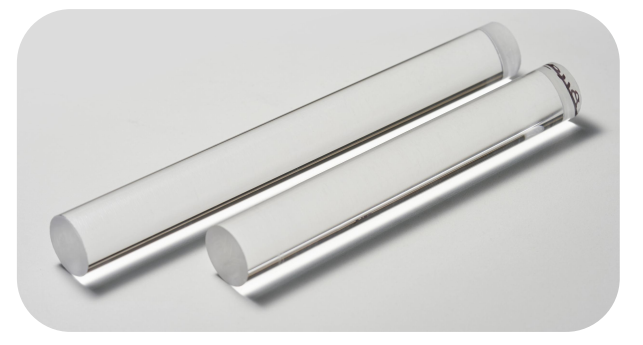
Case background: Challenges of deep hole processing of quartz glass
A European and American special optical fiber manufacturer needs to process a batch of quartz glass preforms for core components of optical fiber signal transmission. The product specifications are cylinders with a diameter of 30mm and a length of 250mm. Two through holes with a diameter of 7.8mm and a depth of 250mm need to be processed inside (depth-to-diameter ratio of 32:1). The hole wall roughness requirement is Sa<0.8μm, and the parallelism error of the two holes must be less than 0.02mm. Such high-precision deep holes directly affect the efficiency and reliability of optical fiber transmission, but traditional processing technology is difficult to meet the needs.
Industry pain points and processing difficulties
Quartz glass has become a key material in the special optical fiber industry due to its high hardness and low thermal expansion coefficient, but its deep hole processing faces three major bottlenecks:
Surface quality defects: Traditional drilling causes the hole wall roughness to exceed the standard (Sa>0.8μm) and is prone to microcracks;
Insufficient stability in deep hole processing: When the depth-to-diameter ratio exceeds 30:1, chip removal is difficult, causing tool breakage and a scrap rate of up to 50%;
Porous precision out of control: The parallelism of the two holes is affected by the rigidity and thermal deformation of the machine tool, and the measured error is generally >0.03mm.
Innovative solutions: ultrasonic process and dynamic control
In response to the above problems, industry-leading companies use ultrasonic green and efficient drilling and milling technology, combined with precision machining systems:
"Ultrasonic vibration assisted cutting": reduce cutting force through 20-40kHz high-frequency vibration, reduce edge collapse and surface damage, and improve hole wall consistency;
"Center water high-pressure cooling": optimize the flow direction and pressure of the coolant (5-8MPa) to ensure deep hole chip removal efficiency and avoid tool breakage;
"Multi-axis dynamic compensation": adjust the feed rate and trajectory based on real-time monitoring data to control the thermal deformation error within ±1μm.
Comparison of machining effects
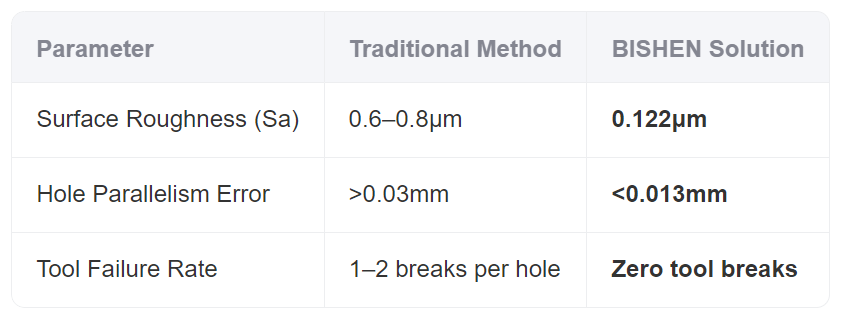
Measured data show that the new solution will increase machining efficiency by 200%, reduce unit cost by 35%, and the qualified rate will jump from 48% to 97%.
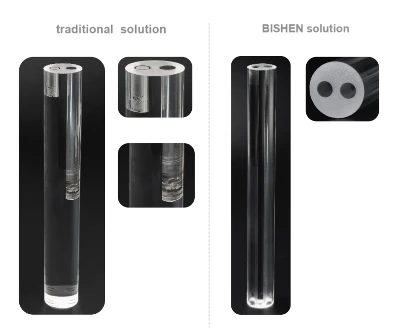
Technology application prospects
In high-growth fields such as 5G communications and laser sensing, the demand for quartz glass precision parts has increased by an average of 12% per year. Ultrasonic deep hole machining technology is becoming a benchmark process in special optical fiber, semiconductor packaging and other industries with its high precision, low damage and strong stability.
About MID
MID is a world-leading provider of superhard material processing solutions, focusing on the research and development of high-precision manufacturing technology, and its service areas cover fiber-optic communications, aerospace and medical devices. Relying on core technologies such as ultrasonic processing and nano-laser minimally invasive, MID has provided customized solutions to customers in more than 30 countries, promoting precision manufacturing towards the goal of "zero defects".
Conclusion: Precision deep hole processing is the key to breakthroughs in the performance of quartz glass components. Through technological innovation and process iteration, the industry is meeting the extreme requirements of cutting-edge technology for materials with higher efficiency and lower cost.


