



There are often various defects in castings. If you are not familiar with or do not understand them before, it is easy to be confused just by the names of some defects. For example, the four defects we are going to talk about today: shrinkage and pores, cold shut and wrinkles. Do you know how they are formed and what are the differences? Let's take a look at them together today.
Let's look at shrinkage and pores first. It will be easier to understand with pictures.
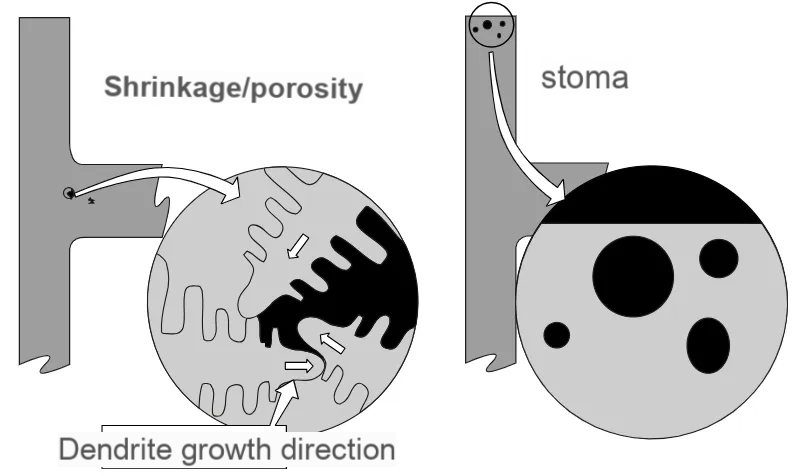
Shrinkage, which we also call shrinkage porosity, is caused by the volume deficit caused by the volume shrinkage of the material during the solidification process, and the volume deficit is not adequately compensated. Since the solidification of metal liquid usually starts from the surface, shrinkage or shrinkage often occurs in the area inside the part material where the cooling is relatively slow, generally in the area where the material is thicker. From the appearance, the edge of shrinkage or shrinkage is usually determined by the dendrite growth structure, mostly irregular shape. As shown on the left side of the above figure.
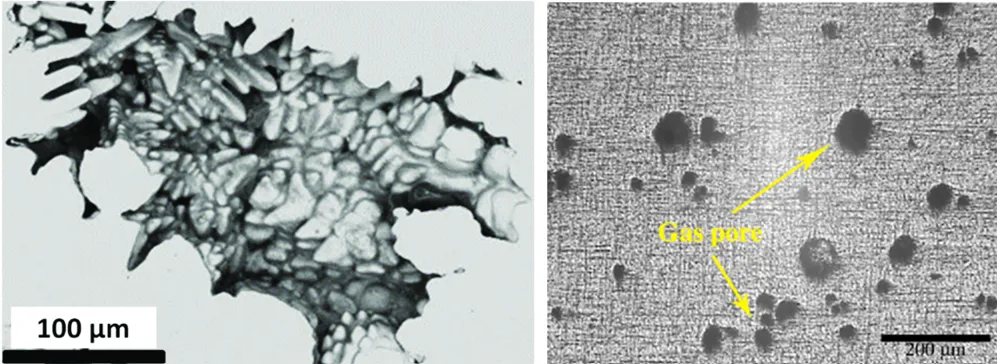
Porosity is usually caused by the inability of the gas in the casting to be discharged in time. The formation of these gases is related to the vacuum degree of the cavity, the use of adhesives and release agents, and the vaporization of water condensed on the surface. They often form in areas where bubbles tend to gather, such as near the core, below the surface of the casting, or on the surface of the casting. From the appearance, the pores are usually spherical and smooth. See the figure above for a comparison with shrinkage cavities.
Now let's look at cold shut and wrinkles. Let's put two pictures for comparison.
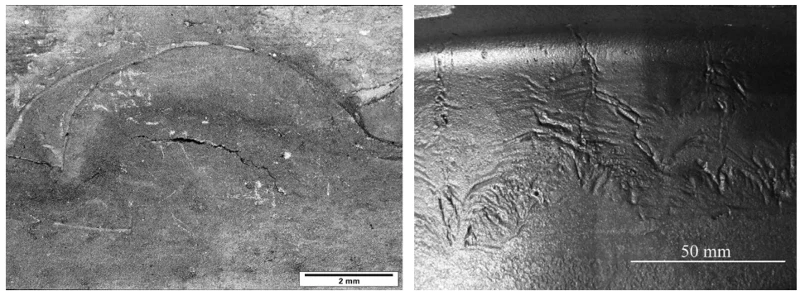
The defect on the left is a cold shut, which refers to a surface discontinuity formed when two streams of metal converge but fail to merge well. It often occurs in areas far away from the gate. Its main feature is obvious, irregular, concave linear lines. Its edges are usually smooth at the junction, and there may also be fractures. This defect is usually caused by improper temperature control, too slow pouring speed, or turbulence in the mold that disrupts the flow of metal.
Wrinkles, as the name suggests, are many wrinkles on the surface of the casting. In most cases, it is caused by high alloy temperature and low mold temperature. At this time, the alloy will rebound from the cooler heat front, resulting in wrinkles. Sometimes, if the liquid metal forms a solid, slightly hard oxide film on the surface, this wrinkle will also appear after molding. If you look at wrinkled leather under magnification, it is usually rough and porous.
I believe that through the above introduction, you have a better understanding of these four defects. If there is anything else that is easy to confuse, please leave a message at the bottom.(文章来源: iMechanics机械)


