




CNC Machining Metal Parts for Medical Devices: What the Regulatory Shift in 2026 Means for Your Supplier List
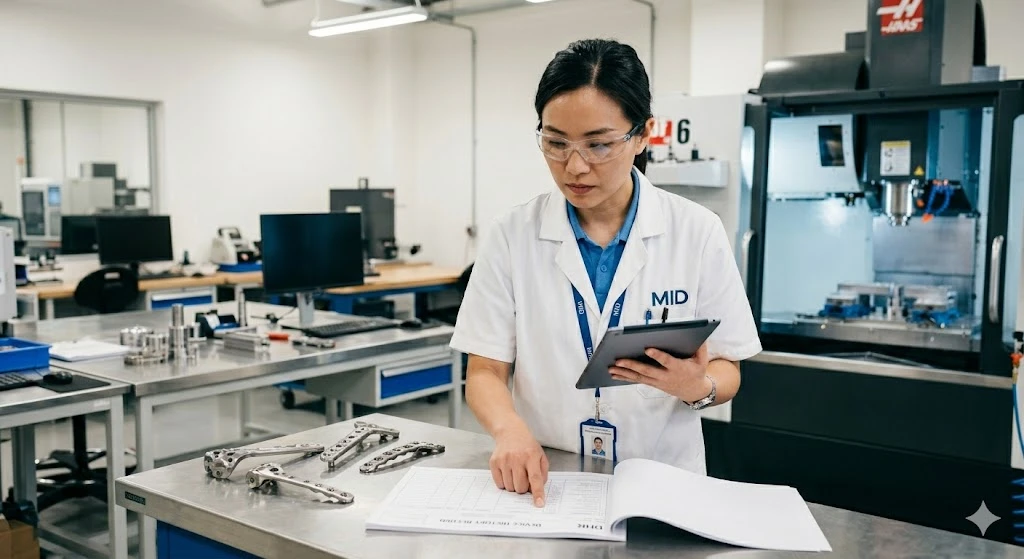
A surgical instrument housing passes dimensional inspection. Material cert is on file. The shop ships on time. Six months later, your OEM customer pulls the lot because the machining supplier couldn't produce a Device History Record that traced the specific bar stock back to the raw material certificate. No record, no traceability, no compliance. The entire batch gets quarantined - not because the parts were out of spec, but because the paperwork didn't exist.
This is not an edge case. It's one of the most common ways medical device supply chains fail audit. And it's the clearest illustration of what separates CNC machining medical device components from general industrial machining: the documentation is part of the product. A part that machines correctly but can't be traced is, from a regulatory standpoint, a nonconforming part.
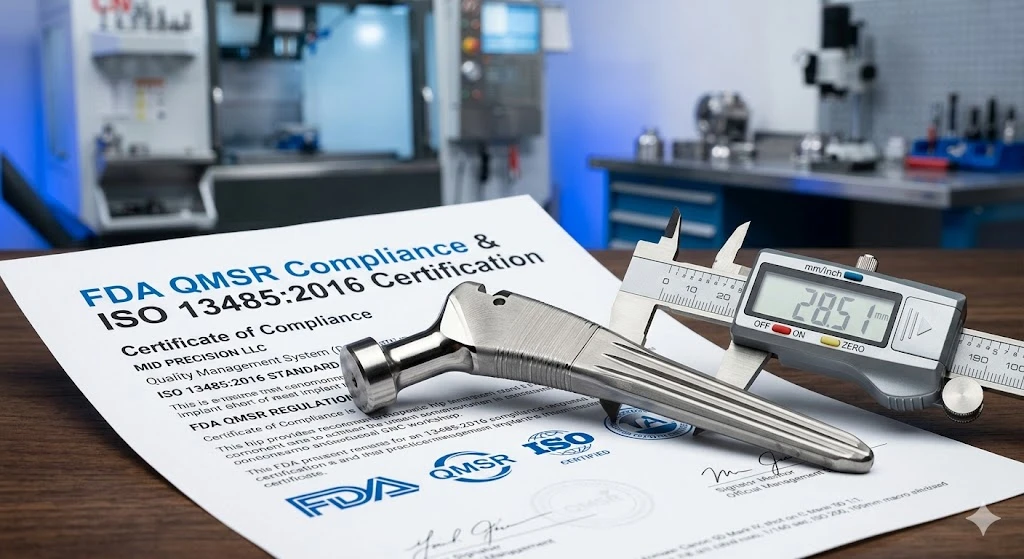
As of February 2, 2026, the FDA's new Quality Management System Regulation (QMSR) took effect, formally incorporating ISO 13485:2016 into 21 CFR Part 820. This means any supplier in your chain serving FDA-regulated devices now operates under a regulatory framework that explicitly requires risk management participation, process validation, and corrective action documentation - not just dimensional inspection. If your current ISO 13485 CNC machining supplier was qualified under the old QSR regime and hasn't updated their systems, that qualification may no longer hold under audit.
Why Medical CNC Machining Is a Different Discipline Entirely
The tolerance requirements on medical components are often severe - but tolerances alone don't define this space. Aerospace also demands tight tolerances. What makes medical device machining distinct is the combination of biocompatibility requirements, lot-level traceability, process validation, and regulatory documentation that runs parallel to every machining operation.
An implant housing machined to ±0.005mm from non-certified 316L bar stock is not a medical-grade part. A surgical drill guide with perfect geometry but no first-article inspection report tied to its production lot is not a deliverable for a regulated product. The machining is necessary but not sufficient. The system behind the machining is what qualifies the part.
This is also why the question "do you have ISO 13485?" is the wrong first question to ask a potential ISO 13485 CNC machining supplier. The right question is: "Show me a sample Device History Record from a recent medical production lot." The answer tells you whether the certificate reflects a functioning quality system or a document that passed a certification audit and hasn't been touched since.
Typical Medical Parts and the Machining Challenges Behind Them
| Component Type | Material | Key Machining Challenge |
|---|---|---|
| Orthopedic implant body (hip stem, tibial tray) | Ti-6Al-4V, CoCrMo | Titanium's low thermal conductivity causes heat buildup; tool wear is rapid; chip clearance on deep features critical |
| Surgical instrument handle | 17-4PH stainless, 316L | Work hardening on 316L requires sharp tooling and controlled feed rates; surface finish spec for sterilization compatibility |
| Implant screw / bone fixation fastener | Ti-6Al-4V, grade 23 | Thread form accuracy and surface finish on root radius; Swiss turning for small-diameter consistency |
| Endoscope component housing | 6061-T6 aluminium, PEEK | Thin walls prone to deflection; PEEK requires dry cutting with positive-rake tooling |
| Dental abutment | Titanium grade 4 | Sub-0.01mm fit tolerance at mating interface; 5-axis required for compound angles |
| Diagnostic instrument chassis | 6061-T6, 303 stainless | Complex multi-face geometry; GD&T callouts on mating surfaces require single-setup machining |
| Drug delivery device component | 316L stainless | Biocompatibility of surface finish; electropolish readiness after machining |

The titanium challenge is worth expanding. Ti-6Al-4V is the dominant implant material for a reason - strength-to-weight ratio, osseointegration compatibility, corrosion resistance. But it machines at roughly one-third the speed of stainless steel, generates extreme heat at the cutting zone, and work-hardens if the tool dwells. A shop that runs titanium correctly is running slower, changing tools more frequently, and monitoring in-process temperature actively. A shop quoting titanium implant components at the same price as stainless work either hasn't run it seriously or isn't planning to run it correctly.
Materials for Medical Grade CNC Machined Metal Parts
Not every metal that meets a dimensional spec is appropriate for medical use. Biocompatibility, sterilization compatibility, and corrosion resistance in biological environments all constrain the material selection.
| Material | Biocompatibility | Sterilization Compatible | Typical Medical Use | Key Machining Note |
|---|---|---|---|---|
| Ti-6Al-4V ELI (Grade 23) | Excellent | Yes (all methods) | Load-bearing implants, spinal hardware | Slow speeds, sharp tooling, high coolant flow |
| 316L Stainless Steel | Good | Yes (all methods) | Surgical instruments, housings, fittings | Work-hardens; sharp tooling, controlled feeds |
| 17-4PH Stainless (H900) | Good | Yes | Instrument handles, structural components | Age-harden before finish machining for stability |
| CoCrMo (ASTM F75) | Excellent | Yes | Articulating implant surfaces | Extremely abrasive; premium tooling required |
| PEEK | Excellent | Yes (autoclave) | Trial implants, instrument components | Dry cutting preferred; positive rake tooling |
| 6061-T6 Aluminium | Limited (non-implant) | Yes | Diagnostic housings, non-contact components | Easy to machine; not for implantable use |
One detail that matters at the drawing stage: medical grade cnc machined metal parts require material certs to specific standards, not just generic alloy designation. "316L stainless" on a print is not sufficient for a regulated product. The cert needs to reference ASTM A276, ASTM F138 (implant grade), or equivalent, and that specific cert needs to be tied to the production lot in the Device History Record. If your supplier can't explain the difference between ASTM A276 and F138 316L, they haven't run medical device work at a level that passes FDA scrutiny.
Compliance Requirements and How a Qualified Supplier Meets Them
| Regulatory Requirement | What It Actually Demands | How MID Precision Satisfies It |
|---|---|---|
| ISO 13485:2016 certification | Documented QMS covering design control, risk management, process validation, CAPA | Certified QMS; scope covers precision machined components for medical devices |
| FDA QMSR (21 CFR Part 820, effective Feb 2026) | ISO 13485 alignment; process validation; design history file support | QMS updated to QMSR-aligned procedures; DHR produced per production lot |
| Material traceability | Raw material cert tied to specific production lot through to final inspection | Bar stock cert → job traveller → CMM report → shipping documentation, all linked by lot number |
| First Article Inspection (FAI) | Dimensional report against all print callouts, signed by quality | Full balloon drawing + CMM report as standard deliverable on first articles |
| CAPA documentation | Documented corrective action with root cause analysis and verification of effectiveness | 8D-format CAPA records maintained; available for customer audit |
| Biocompatibility material certs | ASTM F138 / ISO 5832 or equivalent for implant-contact materials | Medical-grade material certs specified at order entry; copies included with shipment |
| Process validation (IQ/OQ/PQ) | Evidence that the machining process consistently produces conforming output | Process capability data (Cpk) available on critical features for validated production jobs |
The question an experienced medical device procurement engineer will ask that separates real suppliers from paper-qualified ones: "Can you provide the Device History Record for your last five production lots of a comparable part, with the raw material cert, in-process inspection records, and final CMM report all traceable to a single lot number?"
A supplier with a functioning system answers yes and can pull the records in an hour. A supplier whose ISO 13485 cert exists primarily for marketing purposes will ask you what a DHR is, or offer to create one after the fact.

What MID Precision Does - and Doesn't Do - in Medical Device Work
We machine CNC machining medical device components across several categories: surgical instrument housings and handles, diagnostic equipment structural components, implant-adjacent fixturing and trial components, and custom precision parts for medical device OEM customers in the US, EU, and Japan.
Our ISO 13485-compliant quality system produces Device History Records as a standard deliverable on all medical production work - not on request. Every medical job at MID runs with a job traveller that links raw material cert to in-process inspection records to final CMM report under a single lot number. First-article packages include a fully ballooned drawing against the CMM report. CAPA records are maintained and available for customer audit.
Our precision CNC machining capability covers 3-axis, 4-axis, and 5-axis milling, CNC turning, and Swiss CNC turning for small-diameter precision components. We hold ±0.002mm on qualifying features and Ra 0.02µm on surface finish. Material range for medical work includes Ti-6Al-4V ELI (Grade 23), 316L to ASTM F138, 17-4PH, CoCrMo, PEEK, and 6061-T6 for non-implant applications.

Where we draw our own boundary: we do not machine final implantable devices that require cleanroom assembly or sterilization as part of our scope. We machine the components; final assembly and sterile packaging remain with the OEM or their designated cleanroom partner. We're also explicit that our ISO 13485 scope covers machined components - not full device manufacturing. If your qualification requires a supplier with full device manufacturing scope under 13485, that's outside what we offer, and we'll tell you that before you spend time qualifying us.
For medical grade CNC machined metal parts that require full DHR traceability, FAI packages, and CAPA-capable quality systems - and where the scope is machined components delivered to your assembly or inspection team - we're a fit and we can demonstrate it with records, not claims.
Request a capability statement specific to medical device machining - we'll send you our ISO 13485 certificate, scope definition, sample DHR structure, and a sample FAI package from a comparable job within one business day.
If you're ready to move forward, send your NDA and drawing to our engineering team. We review medical RFQs with DFM feedback included - tolerance callouts, material spec completeness, and any features that would affect compliance documentation - before the quote goes out.
FAQ
Q: Our OEM customer requires FDA QMSR compliance from all Tier 2 suppliers. Does ISO 13485 cover that now?
As of February 2, 2026, yes - the FDA's QMSR formally incorporates ISO 13485:2016 by reference, meaning a current ISO 13485 certification is the foundation of QMSR compliance. However, certification alone isn't sufficient. Your OEM customer's qualification audit will also look at process validation records, CAPA history, and whether your supplier's quality system is actively maintained versus just certified. Ask any candidate supplier for their last internal audit report and most recent CAPA closure - those documents show whether the system is live.
Q: We need Ti-6Al-4V ELI (Grade 23) parts with ASTM F136 material certs. Can you source and certify to that standard specifically?
Yes. We specify ASTM F136-compliant Ti-6Al-4V ELI at order entry for medical jobs and require mill certs to that standard from our material suppliers. The cert is included in the DHR package with each shipment. If your print references a different implant-grade titanium standard - ISO 5832-3, for example - confirm the specific revision at order placement and we'll source to it.
Q: What's the difference between ISO 9001 and ISO 13485 for a machining supplier, practically speaking?
ISO 9001 is a general quality management standard focused on customer satisfaction and process improvement. ISO 13485 is specifically designed for medical device supply chains and adds requirements that 9001 doesn't cover: risk management integrated into product realization (linked to ISO 14971), explicit requirements for process validation, device history records, and regulatory compliance as an explicit output of the quality system. A supplier with only ISO 9001 has a quality system. A supplier with ISO 13485 has a quality system built for the regulatory requirements your device will face. For any component going into an FDA-regulated or CE-marked device, 9001 alone is not an adequate supplier qualification.
Q: How do you handle a nonconformance found at our incoming inspection after shipment?
We open a formal CAPA record on our end, which includes root cause analysis, containment action, corrective action, and verification of effectiveness before the CAPA is closed. We'll send you the 8D-format report within five business days of the NCR notification, with interim containment confirmed within 24 hours. For any lot under question, we hold our retained samples pending your disposition decision. Replacement parts, if required, are prioritized through our scheduling system. The CAPA record is available for your supplier audit file.


