



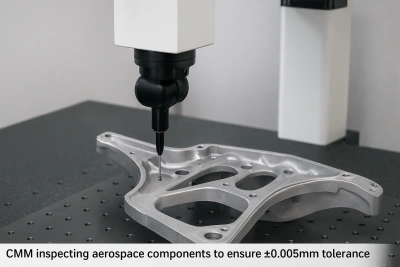
In aerospace manufacturing, precision is not just a slogan-it is the foundation of safety, performance, and compliance. For critical components, tolerances as tight as ±0.005mm (or even higher) have become standard. Achieving this level of accuracy requires more than advanced machinery-it demands a complete system of processes, inspection, and quality management. For European and U.S. manufacturers, understanding how suppliers handle such ultra-precision is key to reducing supply chain risks.
Why Such Strict Tolerances Are Necessary
Safety and Reliability
In aviation, even minor dimensional deviations can reduce structural strength, compromise fuel efficiency, or prevent proper assembly. ±0.005mm precision ensures components perform reliably under high loads and extreme conditions.
Interchangeability Across Global Supply Chains
Aerospace components are often produced by multiple suppliers worldwide. Micron-level tolerances guarantee seamless interchangeability during assembly, reducing rework and assembly risks.
Regulatory and Certification Requirements
The aerospace industry strictly follows quality standards such as AS9100, NADCAP, and ISO 9001, where tolerance control is essential. Suppliers who cannot consistently deliver ±0.005mm precision are unlikely to obtain these certifications or enter the aerospace supply chain.
Key Factors European and U.S. Buyers Should Assess
1.Process Capability and Stability
It's not just about machine precision-process stability is critical. Suppliers demonstrating Cpk and Ppk indices above 1.67 show that their manufacturing processes are reliable.
2.Temperature and Humidity Control
Precision machining at ±0.005mm requires tightly controlled environments. Workshops must maintain stable temperatures (typically ±1℃) and humidity to prevent material expansion or contraction.
3.Inspection and Measuring Equipment
Standard calipers and gauges are insufficient. Suppliers using high-precision coordinate measuring machines (CMM), laser interferometers, and in-process probes can validate every step of the machining process.
4.Experience with Aerospace Materials
Materials like titanium alloys, Inconel, and aluminum-lithium alloys are challenging to machine and prone to distortion or burrs. Only experienced suppliers can maintain precision while controlling surface quality and stress release.
5.Quality Management Systems
Beyond inspection, suppliers need Statistical Process Control (SPC), full traceability, and corrective action loops to ensure every batch consistently meets ±0.005mm standards.
The Real Value of a Supplier
Choosing an aerospace machining supplier is not about finding the lowest price-it's about minimizing risk. A supplier with aerospace certifications and a proven ability to consistently deliver micron-level precision saves manufacturers from delays, rework, and compliance failures.
For OEMs and Tier 1 suppliers, this means more than just receiving a part-it ensures supply chain security and reliability.


