




Aerospace CNC Machining: Build the Traceability Chain Your FAI and Supplier Audit Will Demand
Your structural bracket reaches first-article inspection. The auditor opens AS9102 Form 2 and asks one thing: can every Ti-6Al-4V fitting trace back to the heat it was melted from, and was that heat melted in a DFARS-qualifying country? If that answer lives in three separate inboxes, the FAI stalls. The part is fine. The paperwork is not. For programs heading into a defense or commercial-aircraft supply chain, the document chain is where aerospace CNC machining suppliers pass or fail. We build that chain alongside the part, not after it.
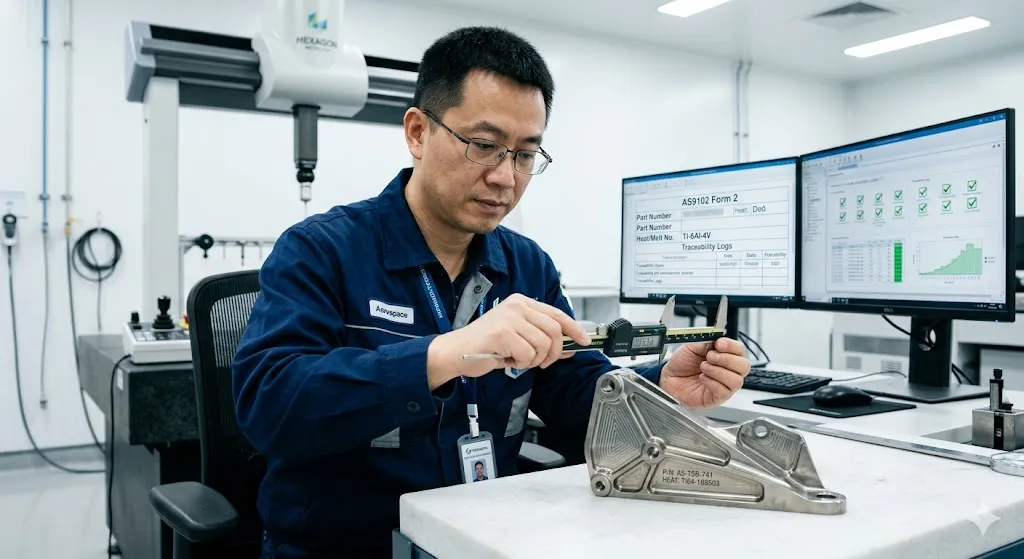
What "Traceable" Means in Aerospace CNC Machining
Aerospace material traceability is not a single certificate. It is an unbroken line from the finished part back to the mill heat or melt lot. For specialty metals, that line carries a legal weight buyers in other industries rarely face. Under DFARS 252.225-7009 - the clause currently dated January 2023 - titanium, titanium alloys, many high-alloy steels, nickel and cobalt-base alloys, and zirconium must be melted or produced in the United States or a qualifying country. The melt origin has to be documented and traceable to the specific material batch, usually through a mill test report and a certificate of conformance.
So when we quote a part for a defense program, the first thing we confirm is the spec on your drawing and whether the melt source must be DFARS-qualified. We log the heat number against the work order at material receiving. That number follows the lot through every operation and lands on the cert package you receive. Aerospace material traceability works only when the link is captured at the start; reconstructing it after machining is how gaps appear. Our precision aerospace CNC machining workflow ties the heat number to the router before the first cut.
Aerospace Alloys and How They Machine
Different aerospace alloys demand different tooling, speeds, and documentation. The table below maps the families we run most often for CNC machining in aerospace work.
| Material / Grade | Machinability | Documentation flag | Typical aerospace use |
|---|---|---|---|
| Aluminum 7075-T6 | High; fast metal removal | Mill cert; DFARS if defense | Structural brackets, housings, fittings |
| Titanium Ti-6Al-4V | Low; heat-sensitive, work-hardens | DFARS melt source; mill cert to heat | Engine fittings, airframe joints, fasteners |
| Stainless 15-5 PH / 17-4 PH | Moderate; heat-treat condition matters | Cert with temper/condition; heat-treat record | Actuator parts, shafts, valve bodies |
| Inconel 718 | Difficult; abrasive, work-hardens | DFARS nickel alloy; full traceability | Hot-section hardware, high-temp brackets |
| Aluminum 6061-T6 | High; general purpose | Mill cert | Fixtures, secondary structure, prototypes |
We run these on 5-axis and Swiss-type machining so geometry and material choice stay independent of fixturing limits. The documentation flag is the column procurement should read first, because it drives the cert package, not the cut.
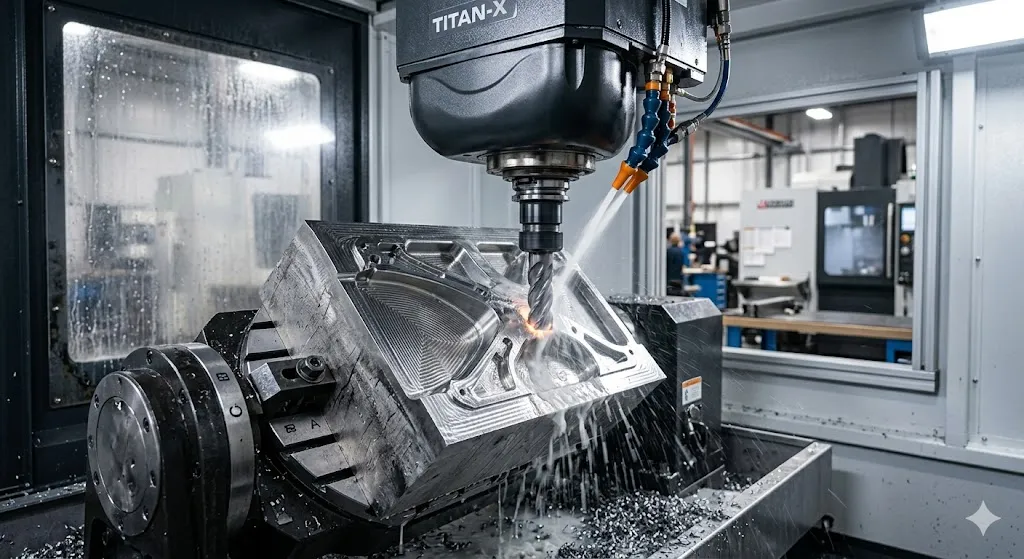
A Note on Titanium: Speeds, Feeds, and Heat
Titanium aerospace machining punishes the wrong strategy quickly. Ti-6Al-4V has low thermal conductivity, so heat does not flow into the chip the way it does with aluminum. It stays at the cutting edge. Push surface speed too high and the edge breaks down; back off the feed and the tool rubs instead of cuts, which work-hardens the surface and makes the next pass worse.
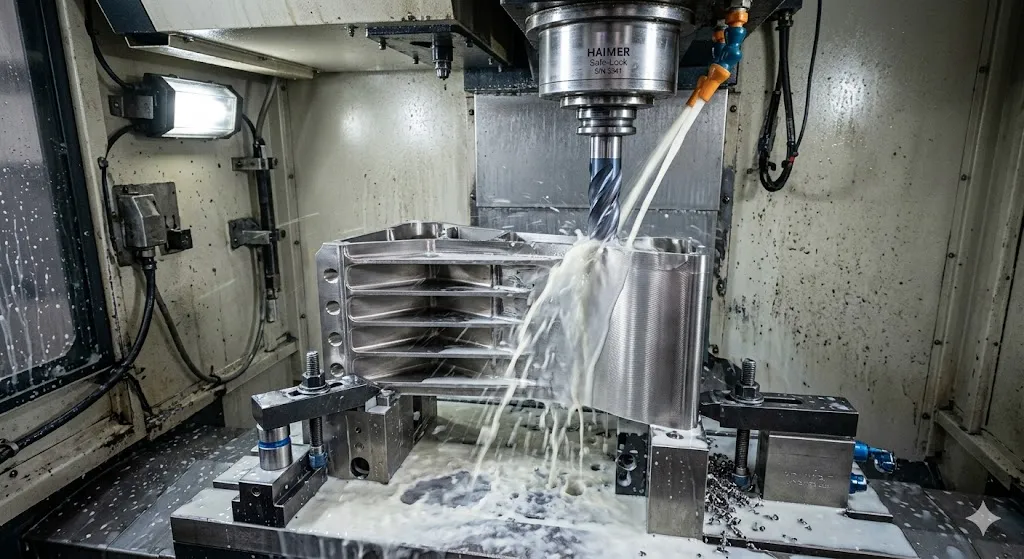
Our practice for Ti-6Al-4V on carbide holds surface speed in a conservative band and keeps the chip load constant, so the tool always cuts rather than rubs. We run high-pressure coolant through the tool to pull heat out of the cut and clear chips before they recut. Setups stay rigid and we avoid dwell at the end of a pass. For thin-wall titanium aerospace machining, we stage roughing and finishing so residual stress does not pull the part out of tolerance after it leaves the fixture. None of this is exotic. It is disciplined, and it keeps Ra and dimensional results repeatable across a lot - which is the point when the FAI sample has to represent the run.
AS9102 First Article Inspection: The Fields Procurement Misses
AS9102 first article inspection is where the part and the paper meet. SAE's current revision, Rev C, has been in force since June 28, 2023, and it tightened a few areas procurement teams still miss on incoming packages.
The most common gap sits in Fields 15–18 on Form 1. Rev C states plainly that every BOM item - detail parts, sub-assemblies, and commercial off-the-shelf items - has to be listed. Buyers who only check the top-level part number let COTS and standard catalogue items slip off the report. Rev C also renamed Field 17 to "Part Type," so the form now expects you to declare whether each line is a detail part, sub-assembly, software, standard catalogue item, or COTS.
Form 2 is the other weak spot. It captures materials, special processes, and functional testing. The field procurement most often skips is the tie between each special process and an accredited source at the correct specification revision. If a part needs heat treatment, anodize, or NDT, those are special processes; many programs expect them performed at a Nadcap-accredited facility, and the AS9102 first article inspection package should show the spec, the revision, and the source. We assemble Form 1, 2, and 3 so these links are explicit, and we balloon the drawing to Form 3 so every characteristic carries a number an auditor can follow. A clean AS9102 first article inspection package shortens your incoming review; a vague one sends it back.

The Documentation Package We Hand You
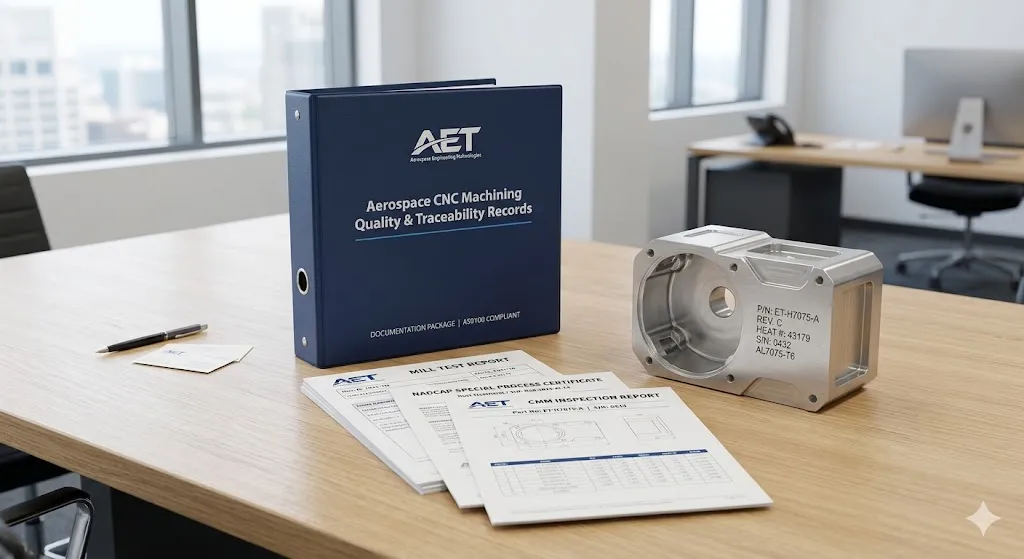
We treat documentation as a deliverable, not an afterthought. The package below is what we hand a regulated buyer with an aerospace CNC machined parts order.
| Document | What it proves | Where it lands in your file |
|---|---|---|
| Mill test report + CoC | Material grade, heat number, melt origin | Material traceability / DFARS record |
| AS9102 Form 1–3 (Rev C) | Part, product, and characteristic accountability | FAI package |
| Special process certs | Heat treat, NDT, coating at correct spec | Form 2 backup, Nadcap evidence |
| Inspection / CMM report | Dimensional results against ballooned print | FAI Form 3, lot acceptance |
| Certificate of conformance | Lot conforms to PO and drawing revision | Receiving / supplier file |
This is the data that feeds your supplier qualification and your own internal review, the way a machined detail's records flow into a higher-level assembly file. Our traceability documentation is structured to drop into that file without rework.
The standards behind this are moving, and you should plan for the change. The IAQG is rebranding AS9100 as IA9100, with publication targeted for late 2026 to align with ISO 9001:2026, whose Draft International Standard was released on August 27, 2025. Industry briefings from certification bodies expect tighter supplier flow-down and stronger counterfeit-parts and traceability controls. Our aerospace CNC machining process already captures the traceability data those changes point toward, so the transition does not reset your supplier file.
FAQ
Can you provide mill certs traceable to heat number for every batch, with DFARS melt origin?
Yes. We capture the heat number at receiving and carry it through the router to the cert package. For defense work, we confirm the melt source against DFARS 252.225-7009 before we buy material, and the certificate of conformance states the melt origin.
How do you handle a drawing revision change mid-program on a CNC machined part?
We freeze the part to a specific drawing revision on the work order and the CoC. A revision change opens a new work order, and where the change affects form, fit, or function, it triggers a partial or full AS9102 first article inspection per Rev C. You get a clear record of which lots were built to which revision.
Do you support Nadcap-accredited special processes?
We coordinate heat treatment, NDT, and coating through accredited sources and document each on Form 2 at the correct specification revision. If your program names specific approved processors, we flow that requirement down.
Send us the drawing and the spec call-outs. We will tell you the material lead time, the melt-source path, and exactly what your FAI package will contain. Talk to our aerospace team about your traceability requirements, or request our AS9102-aligned documentation sample to see how it fits your supplier file.


