



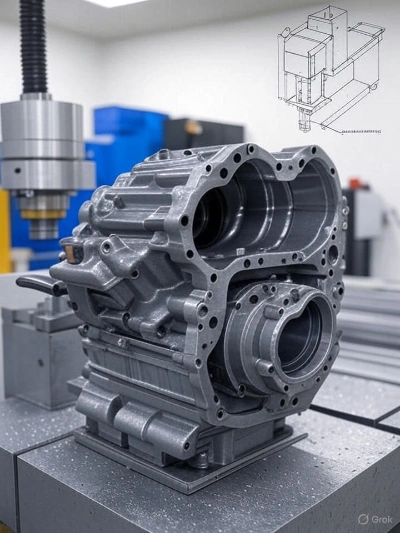
In the manufacturing of aero-engine housings, achieving precise concentricity across multiple stepped holes is critical. These components demand a coaxiality tolerance of less than 0.01 mm to ensure optimal performance and reliability in high-stress environments. The intricate geometry and stringent requirements make this a complex challenge for manufacturers.
The Challenge
Deep hole machining presents significant hurdles, particularly in maintaining concentricity. Tool deflection during extended drilling operations often leads to misalignment, compromising the coaxiality of stepped holes. This issue is exacerbated by the need for high precision across multiple tiers, where even minor deviations can result in costly rework or component failure.
The Solution
To address these challenges, a sophisticated approach combining advanced tooling and real-time monitoring was implemented:
Precision Guide Bushings: Custom-designed guide bushings were utilized to stabilize the cutting tool, minimizing deflection during deep hole drilling. These bushings ensured consistent tool alignment, maintaining the required coaxiality across all steps.
Flexible Boring Bars: Specialized flexible boring bars were employed to adapt to the complex geometry of the housing. Their design allowed for controlled deformation, reducing vibration and improving machining accuracy.
In-Line Measurement and Correction: Real-time measurement systems were integrated into the machining process to monitor concentricity at each stage. Deviations were instantly detected, allowing for immediate tool path adjustments to maintain the 0.01 mm tolerance.
Results
This integrated approach delivered exceptional outcomes. The aero-engine housings achieved consistent coaxiality within the 0.01 mm specification, significantly reducing scrap rates and enhancing production efficiency. The solution also improved tool life and minimized downtime, offering a scalable model for high-precision manufacturing.
Why It Matters
For manufacturers serving the aerospace industry, precision in components like aero-engine housings is non-negotiable. This case demonstrates how innovative tooling and process control can overcome the challenges of deep hole machining, ensuring compliance with rigorous tolerances while optimizing production workflows. By adopting these techniques, manufacturers can enhance quality, reduce costs, and maintain a competitive edge in the global market.


