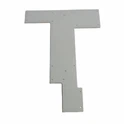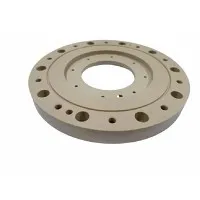

Hey there! As a supplier specializing in CNC machining of PEEK (Polyether Ether Ketone), I often get asked about the thermal conductivity of PEEK in the context of CNC machining. So, let's dive right into it and break down what this means and why it matters.
First off, what's thermal conductivity? In simple terms, it's a measure of how well a material can conduct heat. When we're talking about PEEK in CNC machining, thermal conductivity plays a huge role. During the CNC machining process, a lot of heat is generated. The cutting tools rub against the PEEK material, and this friction creates heat. If the material can't conduct that heat away effectively, it can lead to a bunch of problems.
PEEK has a relatively low thermal conductivity compared to metals. Typically, the thermal conductivity of PEEK ranges from about 0.25 - 0.35 W/(m·K) at room temperature. To put that in perspective, metals like aluminum have a thermal conductivity of around 200 - 240 W/(m·K). That's a massive difference!
Now, why does this low thermal conductivity matter in CNC machining? Well, when heat builds up in the PEEK material during machining, it can cause the material to soften. PEEK has a high melting point (around 343°C), but excessive heat can still make it deform. This deformation can lead to inaccurate machining dimensions, which is a big no - no in precision manufacturing.
Another issue is tool wear. When the heat isn't dissipated properly, the cutting tools are exposed to higher temperatures. This can cause the tools to wear out faster, increasing the cost of production. The low thermal conductivity of PEEK means that we need to be extra careful with our machining parameters.
Let's talk about how we, as a CNC machining PEEK supplier, deal with this. We use a combination of techniques to manage the heat. One of the most common methods is using coolant. Coolants help to carry away the heat generated during machining. They also lubricate the cutting tools, reducing friction and thus the amount of heat produced in the first place.
We also optimize our cutting speeds and feeds. By adjusting these parameters, we can control the amount of heat generated. For example, slower cutting speeds can reduce the heat input, but we need to balance this with production efficiency. It's a bit of a juggling act, but with experience, we've found the sweet spot for machining PEEK.
In addition to coolant and parameter optimization, we also pay close attention to the tool geometry. Using the right tool geometry can help to reduce the heat generated during cutting. For instance, tools with sharp edges can cut through the PEEK more cleanly, generating less heat compared to dull tools.


Now, let's touch on some related materials and their machining. If you're also interested in other plastics for CNC machining, we've got you covered. We offer CNC Machining PMI Foams and PVC. PMI foams and PVC have different properties compared to PEEK. PMI foams are lightweight and have good insulation properties, while PVC is more flexible and cost - effective.
We also provide CNC Machining PPSU. PPSU is another high - performance plastic with excellent chemical resistance and mechanical properties. And for those who need polycarbonate parts, we offer CNC Machining Polycarbonate. Polycarbonate is known for its transparency and impact resistance.
When it comes to choosing the right plastic for your project, the thermal conductivity is just one factor. You also need to consider mechanical strength, chemical resistance, and cost. PEEK is a great choice for applications where high temperature resistance, chemical resistance, and mechanical strength are required. But it might not be the best option if cost is a major concern.
If you're in the market for CNC machined PEEK parts or any of the other plastics we offer, we'd love to hear from you. Whether you're working on a small - scale prototype or a large - scale production run, we have the expertise and equipment to meet your needs. We can work with you to understand your requirements and provide the best solutions.
So, if you're interested in discussing your project further, don't hesitate to reach out. We're here to answer your questions and help you get the best - quality CNC machined parts at a competitive price.
References
- "Engineering Plastics: Properties and Applications" - A comprehensive guide on the properties of various engineering plastics, including PEEK.
- "CNC Machining Handbook" - A practical resource for understanding the machining processes and parameters for different materials.