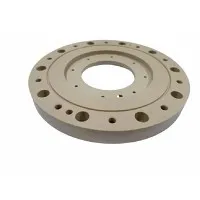

Titanium alloys are renowned for their exceptional strength-to-weight ratio, corrosion resistance, and biocompatibility, making them highly sought after in various industries such as aerospace, medical, and automotive. As a leading supplier of CNC machining titanium alloy parts, we understand the critical importance of maintaining precise tolerances to ensure the quality and performance of these components. In this blog post, we will delve into the typical tolerances for CNC machined titanium alloy parts, exploring the factors that influence them and the techniques we employ to achieve the desired precision.
Understanding Tolerances in CNC Machining
Tolerances in CNC machining refer to the allowable variation from the specified dimensions of a part. They are crucial for ensuring that the part fits and functions correctly within its intended application. Tolerances are typically expressed in units of length, such as millimeters or inches, and can be either unilateral (allowing variation in one direction) or bilateral (allowing variation in both directions).
The tolerance requirements for a particular part depend on several factors, including the application, the material being machined, and the manufacturing process. In the case of titanium alloy parts, achieving tight tolerances can be particularly challenging due to the material's unique properties, such as its high strength, low thermal conductivity, and tendency to work harden.
Typical Tolerances for CNC Machined Titanium Alloy Parts
The typical tolerances for CNC machined titanium alloy parts can vary depending on the specific requirements of the application. However, in general, the following are some common tolerance ranges for different types of features:


Dimensional Tolerances
- Linear Dimensions: For linear dimensions, such as lengths, widths, and heights, typical tolerances range from ±0.05 mm to ±0.2 mm. However, in some high-precision applications, tolerances as tight as ±0.01 mm or even ±0.005 mm may be required.
- Diameter Tolerances: When machining holes or shafts, diameter tolerances typically range from ±0.02 mm to ±0.1 mm. Again, for applications requiring higher precision, tighter tolerances can be achieved.
Geometric Tolerances
- Flatness and Straightness: Flatness and straightness tolerances are used to control the deviation of a surface from a perfectly flat or straight plane. Typical tolerances for flatness and straightness range from ±0.02 mm to ±0.1 mm.
- Roundness and Cylindricity: Roundness and cylindricity tolerances are used to control the deviation of a circular or cylindrical feature from a perfect circle or cylinder. Typical tolerances for roundness and cylindricity range from ±0.005 mm to ±0.02 mm.
- Perpendicularity and Parallelism: Perpendicularity and parallelism tolerances are used to control the orientation of one feature relative to another. Typical tolerances for perpendicularity and parallelism range from ±0.02 mm to ±0.1 mm.
Factors Influencing Tolerances in CNC Machining Titanium Alloy Parts
Several factors can influence the achievable tolerances in CNC machining titanium alloy parts. Understanding these factors is essential for ensuring that the desired precision is achieved. Some of the key factors include:
Material Properties
- Strength and Hardness: Titanium alloys are known for their high strength and hardness, which can make them difficult to machine. The high cutting forces required to machine titanium can cause tool deflection and vibration, leading to dimensional inaccuracies.
- Thermal Conductivity: Titanium has a relatively low thermal conductivity, which means that heat generated during machining can accumulate in the cutting zone. This can cause thermal expansion of the workpiece and the cutting tool, leading to dimensional changes and reduced accuracy.
- Work Hardening: Titanium alloys have a tendency to work harden during machining, which can increase the cutting forces and tool wear. Work hardening can also make it more difficult to achieve tight tolerances, as the material becomes more resistant to deformation.
Machining Process
- Cutting Parameters: The cutting parameters, such as cutting speed, feed rate, and depth of cut, can have a significant impact on the achievable tolerances. Optimal cutting parameters need to be selected to minimize tool wear, reduce cutting forces, and control the heat generated during machining.
- Tool Selection: The choice of cutting tool is also crucial for achieving tight tolerances in CNC machining titanium alloy parts. Tools made from high-speed steel (HSS), carbide, or ceramic materials are commonly used, depending on the specific application and the required precision.
- Machine Tool Accuracy: The accuracy of the CNC machine tool itself is another important factor. Machine tools with high precision and stability are required to achieve tight tolerances consistently. Regular maintenance and calibration of the machine tool are also essential to ensure its accuracy.
Fixturing and Workholding
- Proper Fixturing: Fixturing is the process of securing the workpiece in place during machining. Proper fixturing is essential for ensuring that the workpiece remains stable and does not move or vibrate during machining. This helps to minimize the risk of dimensional inaccuracies and ensures that the desired tolerances are achieved.
- Workholding Devices: The choice of workholding devices, such as vises, clamps, or chucks, can also affect the achievable tolerances. Workholding devices need to be selected based on the shape and size of the workpiece, as well as the required clamping force.
Techniques for Achieving Tight Tolerances in CNC Machining Titanium Alloy Parts
To achieve tight tolerances in CNC machining titanium alloy parts, we employ several advanced techniques and best practices. These include:
Advanced Machining Strategies
- High-Speed Machining: High-speed machining techniques can be used to reduce the cutting forces and heat generated during machining, which helps to minimize tool wear and improve the dimensional accuracy of the parts.
- Precision Grinding: Precision grinding can be used to achieve extremely tight tolerances and surface finishes. Grinding is often used as a finishing operation to remove any remaining material and to improve the dimensional accuracy of the parts.
- Multi-Axis Machining: Multi-axis machining allows for more complex geometries to be machined with greater precision. By using multiple axes of motion, the cutting tool can approach the workpiece from different angles, which helps to reduce the number of setups and improve the overall accuracy of the parts.
Quality Control
- In-Process Inspection: In-process inspection techniques, such as using touch probes or laser scanners, can be used to monitor the dimensions of the parts during machining. This allows for any deviations from the desired tolerances to be detected early and corrected immediately, ensuring that the final parts meet the required specifications.
- Post-Process Inspection: Post-process inspection is also essential to verify the dimensional accuracy and quality of the finished parts. We use a variety of inspection equipment, such as coordinate measuring machines (CMMs), optical comparators, and surface profilometers, to ensure that the parts meet the required tolerances and surface finish requirements.
Conclusion
Achieving tight tolerances in CNC machining titanium alloy parts is a challenging but achievable goal. By understanding the factors that influence tolerances and employing advanced machining techniques and quality control measures, we are able to produce high-quality titanium alloy parts that meet the most demanding specifications.
As a leading supplier of CNC Machining Aluminum Alloy, CNC Machining Brass and Copper, and CNC Machining Nickel-based Alloys, we have the expertise and experience to provide our customers with the highest level of precision and quality. If you are in need of CNC machined titanium alloy parts, we invite you to contact us to discuss your specific requirements and to learn more about how we can help you achieve your goals.
References
- Kalpakjian, S., & Schmid, S. R. (2014). Manufacturing Engineering and Technology. Pearson.
- Paul De Garmo, E., Black, J. T., & Kohser, R. A. (2003). Materials and Processes in Manufacturing. Wiley.
- Trent, E. M., & Wright, P. K. (2000). Metal Cutting. Butterworth-Heinemann.