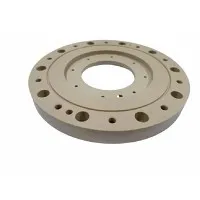

CNC machining has revolutionized the manufacturing industry, offering precision, efficiency, and versatility in producing a wide range of components. Among the materials commonly machined using CNC technology, FR4 and G10 are well - known for their electrical insulation properties, mechanical strength, and chemical resistance. As a supplier of CNC Machining FR4 G10, I have extensive experience in this field. However, it's important to recognize that there are limitations to CNC machining these materials.
Material Characteristics and Their Impact
FR4 and G10 are composite materials made of epoxy resin reinforced with fiberglass. The fiberglass reinforcement provides excellent mechanical properties but also presents challenges during CNC machining.
Hardness and Abrasiveness
The fiberglass in FR4 and G10 is quite hard and abrasive. This hardness causes rapid tool wear during the machining process. Cutting tools, such as end mills and drills, are subjected to high levels of stress as they come into contact with the fiberglass strands. As a result, the cutting edges of the tools become dull quickly, leading to reduced machining accuracy and surface finish. For example, in a long - run production of FR4 components, the initial sharpness of the tool may allow for precise cuts, but as the tool wears, the dimensional accuracy of the machined parts can deviate from the design specifications. This means that frequent tool changes are necessary, which increases production costs and downtime.
Brittleness
Another characteristic of FR4 and G10 is their brittleness. When subjected to high - speed machining forces, these materials are prone to cracking and chipping. During operations like drilling or milling, the sudden application of force can cause the material to fracture at the edges or within the body of the part. For instance, when drilling holes in an FR4 board, if the feed rate and spindle speed are not carefully controlled, the brittle nature of the material can lead to delamination around the hole edges, which not only affects the aesthetic appearance but also the functionality of the component.
Machining Process Limitations
Surface Finish
Achieving a smooth surface finish on FR4 and G10 components can be challenging. The presence of fiberglass strands can result in a rough surface after machining. Even with high - precision machining techniques, the fiberglass may protrude from the surface, causing a textured appearance. This is especially problematic when the components require a specific surface finish for further assembly or coating processes. For example, in applications where the component needs to be bonded to another part, a rough surface finish can reduce the bonding strength. Additionally, the rough surface may also affect the electrical properties of the material in some electrical applications.
Tolerance Control
Maintaining tight tolerances during CNC machining of FR4 and G10 is difficult. The material's inhomogeneous structure, due to the combination of epoxy resin and fiberglass, can lead to variations in machining behavior. During milling operations, for example, the cutting forces may be different when the tool encounters a fiberglass strand compared to the epoxy resin. These variations can cause dimensional inaccuracies in the machined parts. In high - precision applications, such as aerospace or medical devices, where tight tolerances are crucial, these limitations can be a significant drawback.
Heat Generation
CNC machining generates heat, and FR4 and G10 are sensitive to high temperatures. The epoxy resin in these materials can start to decompose at relatively low temperatures, which can lead to changes in the material's properties. Excessive heat can also cause the material to warp or distort, affecting the overall quality of the machined part. To mitigate this issue, coolant is often used during machining. However, the use of coolant can also introduce other problems, such as contamination of the machined surface or corrosion of the tool.


Design Constraints
Complex Geometries
Machining complex geometries in FR4 and G10 can be extremely difficult. The brittleness of the material makes it challenging to create fine features, sharp corners, or thin - walled structures. For example, when trying to machine a part with intricate internal channels or small - diameter holes, the risk of cracking and chipping is very high. In addition, the inhomogeneous nature of the material can make it difficult to ensure uniform machining across the entire part, especially in areas with complex geometries.
Thickness Limitations
There are also limitations when it comes to the thickness of FR4 and G10 components that can be effectively machined. For very thin materials, the risk of breakage during machining is high, especially when using high - speed cutting tools. On the other hand, machining thick FR4 or G10 parts can be time - consuming and may require more powerful machining equipment. The cutting forces required to machine thick materials can also cause more significant tool wear and increase the risk of material deformation.
Comparison with Other Materials
When compared to other materials that can be CNC machined, such as PMI foams, PMMA, and polycarbonate, FR4 and G10 have distinct limitations.
CNC Machining PMI Foams and PVC
CNC Machining PMI Foams and PVC offer better machinability in terms of tool wear. PMI foams are relatively soft, which means that cutting tools experience less wear during machining. PVC also has good machinability and can achieve smoother surface finishes more easily compared to FR4 and G10. The low density of PMI foams also allows for faster machining speeds, reducing production time.
CNC Machining PMMA
CNC Machining PMMA is known for its excellent optical properties and good machinability. PMMA can be machined to very high precision and can achieve a smooth, polished surface finish. Unlike FR4 and G10, PMMA is less brittle, which reduces the risk of cracking and chipping during machining. This makes it a more suitable choice for applications that require high - quality surface finishes and complex geometries.
CNC Machining Polycarbonate
CNC Machining Polycarbonate also has advantages over FR4 and G10. Polycarbonate is a tough and impact - resistant material, which is less likely to crack during machining. It can be machined at high speeds with relatively low tool wear. Additionally, polycarbonate can be easily formed into various shapes, making it more versatile for different design requirements.
Overcoming the Limitations
Despite these limitations, there are ways to minimize their impact. Advanced tooling technologies, such as diamond - coated tools, can significantly reduce tool wear when machining FR4 and G10. These tools have a high hardness and wear resistance, allowing for longer tool life and more precise machining.
Optimizing the machining parameters, such as feed rate, spindle speed, and depth of cut, can also help to reduce the risk of cracking and chipping. By carefully adjusting these parameters, the machining forces can be controlled to suit the properties of FR4 and G10.
In terms of design, engineers can avoid sharp corners and thin - walled structures in the design of FR4 and G10 components. Using fillets and rounded edges can reduce the stress concentration during machining, minimizing the risk of cracking.
Conclusion
As a supplier of CNC Machining FR4 G10, I understand the limitations associated with machining these materials. The hardness, brittleness, and inhomogeneous nature of FR4 and G10 pose challenges in terms of tool wear, surface finish, tolerance control, and the ability to machine complex geometries. However, with the right tools, machining parameters, and design considerations, these limitations can be mitigated.
If you are in the market for CNC - machined FR4 G10 components and are facing the challenges mentioned above, we are here to help. Our team of experts has extensive experience in handling these materials and can provide solutions tailored to your specific requirements. Whether you need high - precision components or large - scale production, we can work with you to overcome the limitations and deliver high - quality products. Contact us to start a discussion about your project and explore how we can meet your needs through effective CNC machining of FR4 G10.
References
- "Machining of Composite Materials" by John Summerscales
- "Handbook of Plastics Machining" by Daniel F. Adams