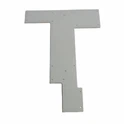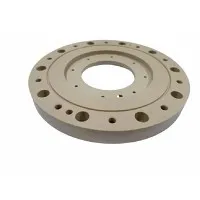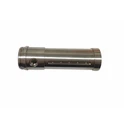

Hey there! I'm a supplier in the milling machining PEEK business, and today I wanna chat about the characteristics of PEEK that have an impact on milling machining.
High Melting Point
PEEK has a really high melting point, around 343°C. This is both a blessing and a curse when it comes to milling. On one hand, it allows PEEK parts to maintain their shape and performance in high - temperature environments. But during milling, the high melting point means that a significant amount of heat is generated. The heat can build up at the cutting edge of the tool, leading to rapid tool wear.
When the tool gets too hot, its hardness decreases, and it starts to deform. This not only reduces the quality of the machined surface but also shortens the tool's lifespan. To deal with this, we often use coolants. Coolants can effectively remove the heat generated during the milling process. They also lubricate the cutting edge, reducing friction between the tool and the PEEK material. This helps to keep the tool in good condition and ensures a smooth machining process.
High Strength and Stiffness
PEEK is known for its excellent strength and stiffness. It can withstand high mechanical loads without significant deformation. In milling, this characteristic means that PEEK can hold its shape well during the machining process. We don't have to worry too much about the material warping or distorting under the pressure of the cutting tool.
However, the high strength and stiffness also make PEEK more difficult to cut compared to some other plastics. The cutting forces required to machine PEEK are relatively high. This means that we need to use high - quality cutting tools with sharp edges. Dull tools won't be able to cut through the PEEK effectively, and they'll cause more heat generation and surface roughness.
For example, carbide tools are often a good choice for milling PEEK. They are hard enough to withstand the high cutting forces and can maintain their sharpness for a longer time. Also, proper tool geometry is crucial. Tools with the right rake angle and clearance angle can reduce the cutting forces and improve the machining efficiency.
Chemical Resistance
PEEK has outstanding chemical resistance. It can resist a wide range of chemicals, including acids, bases, and organic solvents. This is great for applications where the PEEK parts will be exposed to harsh chemical environments. But in milling, it can be a bit of a challenge.
The chemical resistance means that PEEK doesn't react easily with coolants and lubricants. We need to choose the right coolants and lubricants that are compatible with PEEK. Some coolants might not have good wetting properties on the PEEK surface, which can affect the heat transfer and lubrication during the milling process.
We usually use water - based coolants with additives that can improve their performance on PEEK. These coolants can provide good cooling and lubrication while being chemically compatible with PEEK.
Low Friction Coefficient
PEEK has a low friction coefficient, which is beneficial in many applications. It reduces wear and tear in moving parts. In milling, this characteristic can also have an impact.
The low friction coefficient means that the chips generated during milling tend to stick less to the cutting tool. This is good because it reduces the chances of chip - clogging, which can cause poor surface finish and tool damage. However, the low friction also means that it can be a bit difficult to control the chip flow.
We need to design the cutting parameters and tool geometry in a way that can effectively control the chip flow. For example, using tools with chip breakers can help to break the chips into smaller pieces and ensure a smooth chip evacuation.
Crystallinity
PEEK can exist in both amorphous and semi - crystalline forms. The degree of crystallinity affects its mechanical and thermal properties, as well as its machinability.
Semi - crystalline PEEK has higher strength and stiffness but is also more brittle compared to amorphous PEEK. During milling, semi - crystalline PEEK is more likely to crack or fracture, especially when the cutting forces are too high or the machining parameters are not optimized.
Amorphous PEEK, on the other hand, is more ductile and easier to machine. But it has lower strength and stiffness. We need to choose the right type of PEEK based on the specific application requirements and the machining process.
Comparison with Other Plastics
When we compare PEEK with other plastics like PPSU, Nylon, and Polycarbonate, we can see some differences in their milling characteristics.
CNC Machining PPSU is also a high - performance plastic, but it has a lower melting point than PEEK. This means that the heat generated during milling is relatively easier to manage. However, PPSU is not as strong and stiff as PEEK, so the parts made from PPSU might not be suitable for applications with high mechanical loads.
CNC Machining Nylon is a widely used plastic. It is relatively easy to machine because of its lower strength and stiffness. But nylon has poor chemical resistance compared to PEEK. It can absorb moisture, which can affect its dimensional stability and mechanical properties.
CNC Machining Polycarbonate is known for its transparency and good impact resistance. It is easier to machine than PEEK, but it has a lower melting point and is more prone to scratching and cracking.
Conclusion
In conclusion, the characteristics of PEEK, such as its high melting point, strength, stiffness, chemical resistance, low friction coefficient, and crystallinity, all have significant impacts on the milling machining process. As a milling machining PEEK supplier, we need to understand these characteristics well and optimize the machining parameters and tool selection to ensure high - quality machining results.
If you're in the market for high - quality milled PEEK parts, I'd love to have a chat with you. Whether you have specific requirements for the strength, heat resistance, or chemical resistance of the parts, we can work together to find the best solutions. Don't hesitate to reach out and start a conversation about your procurement needs.


References
- "Plastic Materials in Engineering" by Brian Ellis
- "Machining of Polymers" by John A. Schey