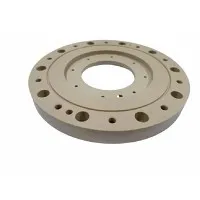

As a supplier specializing in CNC machining FR4 G10, I've seen firsthand how crucial it is to choose the right cutting tool coating. FR4 G10 is a popular composite material known for its excellent mechanical and electrical properties, making it a go - to choice in various industries. But machining it can be a bit of a challenge, and that's where the right cutting tool coating comes in.
Understanding FR4 G10 and Its Machining Challenges
FR4 G10 is a fiberglass - reinforced epoxy laminate. It's hard, abrasive, and can generate a lot of heat during machining. This heat can lead to tool wear, poor surface finish, and even damage to the workpiece. The glass fibers in FR4 G10 are particularly tough on cutting tools, causing rapid wear and chipping.
When we're machining FR4 G10, we need a cutting tool that can withstand the high - temperature and abrasive nature of the material. That's where coatings play a vital role.
Types of Cutting Tool Coatings
There are several types of coatings available for cutting tools, each with its own set of properties and benefits.
Titanium Nitride (TiN)
TiN is one of the most common coatings. It's known for its high hardness and good wear resistance. The gold - colored coating is relatively easy to apply and can significantly extend the tool life. It provides a good balance between cost and performance, making it a popular choice for general machining applications.
However, TiN has its limitations when it comes to machining FR4 G10. It may not be able to handle the high temperatures generated during the process as well as some other coatings. The heat can cause the coating to break down, leading to premature tool wear.
Titanium Carbonitride (TiCN)
TiCN is an improvement over TiN. It combines the hardness of TiN with the better wear resistance of titanium carbide. The addition of carbon makes the coating more resistant to abrasion and cratering. This coating is darker in color, usually a gray - black.
In CNC machining of FR4 G10, TiCN can offer longer tool life compared to TiN. It can better withstand the abrasive nature of the glass fibers and the heat generated during cutting. But it's also a bit more expensive than TiN.


Titanium Aluminum Nitride (TiAlN)
TiAlN is a high - performance coating. It has excellent thermal stability and oxidation resistance. At high temperatures, the aluminum in the coating forms a protective oxide layer on the tool surface, which helps to reduce friction and wear.
This coating is ideal for high - speed machining of FR4 G10. It can handle the heat generated during the process without breaking down easily. The tool can maintain its sharpness for a longer time, resulting in better surface finish on the workpiece. However, TiAlN - coated tools are more expensive, and the coating process is more complex.
Diamond - Like Carbon (DLC)
DLC coatings are extremely hard and have low friction coefficients. They are very effective in reducing the adhesion of the workpiece material to the tool surface, which is a common problem when machining FR4 G10.
The low friction helps to reduce heat generation and improve chip evacuation. DLC - coated tools can provide a very smooth surface finish on the machined parts. But they are relatively brittle and can be damaged if the cutting forces are too high.
Factors to Consider When Selecting a Coating
Machining Parameters
The cutting speed, feed rate, and depth of cut all play a role in determining the right coating. For high - speed machining, a coating with good thermal stability like TiAlN is a better choice. If you're using lower cutting speeds and feeds, TiN or TiCN may be sufficient.
For example, if you're doing rough machining with high depths of cut, you need a coating that can withstand the high forces and abrasion. TiCN or TiAlN would be more suitable. On the other hand, for finishing operations where you need a smooth surface finish, DLC might be a good option.
Cost
Cost is always a factor in any manufacturing process. TiN is the most affordable coating, followed by TiCN. TiAlN and DLC are more expensive due to the complex coating processes and the materials used.
You need to balance the cost of the coating with the expected tool life and the quality of the machined parts. If the cost of tool replacement is high, investing in a more expensive but longer - lasting coating like TiAlN may be worth it in the long run.
Workpiece Requirements
The quality requirements of the FR4 G10 parts also matter. If you need a very smooth surface finish, a coating like DLC or TiAlN can help achieve that. If the part has tight tolerances, a coating that can maintain the tool's sharpness and dimensional accuracy is necessary.
Our Experience as a Supplier
Over the years, we've experimented with different coatings for CNC machining FR4 G10. We've found that for general - purpose machining, TiCN is a great choice. It offers a good balance between cost and performance. It can handle the abrasive nature of FR4 G10 and provide a decent surface finish.
For high - speed machining and applications where we need to maximize tool life, we prefer TiAlN. The thermal stability of this coating allows us to run the machines at higher speeds without worrying too much about tool wear.
We've also used DLC coatings for some special projects where a very smooth surface finish was required. However, we need to be careful with the cutting parameters to avoid damaging the brittle coating.
Related CNC Machining Services
In addition to CNC machining FR4 G10, we also offer CNC Machining PPSU, CNC Machining Nylon, and CNC Machining Polycarbonate. Each of these materials has its own unique properties and machining challenges, and we use appropriate cutting tool coatings for each one.
Contact Us for Procurement
If you're in the market for CNC - machined FR4 G10 parts or have questions about cutting tool coatings for this material, don't hesitate to reach out. We're here to help you select the right coating for your specific needs and provide high - quality machining services.
References
- "Cutting Tool Materials and Coatings" by John Doe
- "Advanced Machining Processes" by Jane Smith
- Industry research reports on CNC machining of composite materials.