Nylon, renowned for its exceptional toughness, has become a staple material in various industries. As a dedicated lathe machining nylon supplier, I've witnessed firsthand how its unique properties can both facilitate and complicate the machining process. In this blog post, we'll explore how the toughness of nylon affects lathe machining, uncovering the challenges and opportunities it presents.
Understanding Nylon's Toughness
Nylon is a synthetic thermoplastic polymer known for its high tensile strength, abrasion resistance, and durability. Its toughness stems from its molecular structure, which consists of long chains of repeating units held together by strong chemical bonds. This molecular arrangement gives nylon excellent mechanical properties, making it suitable for a wide range of applications, from automotive components to consumer goods.
One of the key factors contributing to nylon's toughness is its ability to absorb and dissipate energy. When subjected to stress or impact, nylon can deform elastically, allowing it to absorb energy without breaking. This property makes nylon ideal for applications where resistance to wear, fatigue, and impact is critical.
Advantages of Machining Tough Nylon
The toughness of nylon offers several advantages when it comes to lathe machining. Firstly, its high strength and durability allow for the production of precision components with tight tolerances. Nylon can withstand the forces exerted during machining without deforming or cracking, ensuring consistent and accurate results.
Secondly, nylon's abrasion resistance makes it an excellent choice for applications where the machined parts will be exposed to friction or wear. Lathe-machined nylon components can maintain their dimensional accuracy and surface finish over extended periods of use, reducing the need for frequent replacement.
Thirdly, nylon's ability to absorb energy makes it less prone to chipping or breaking during machining. This means that tools can be used for longer periods without dulling or wearing out, resulting in lower tooling costs and increased productivity.
Challenges of Machining Tough Nylon
While nylon's toughness offers many advantages, it also presents some challenges during lathe machining. One of the main challenges is the tendency of nylon to produce long, stringy chips during machining. These chips can become entangled in the cutting tool, causing it to jam or break. To overcome this issue, it's important to use proper cutting techniques and tools designed specifically for machining nylon.
Another challenge is the heat generated during machining. Nylon has a relatively low melting point, and excessive heat can cause the material to soften or melt, resulting in poor surface finish and dimensional accuracy. To minimize heat buildup, it's important to use sharp cutting tools, proper cutting speeds and feeds, and adequate coolant or lubrication.
In addition, nylon's high elasticity can make it difficult to hold the workpiece securely during machining. The material may deform or deflect under the pressure of the cutting tool, leading to inaccurate dimensions and surface finish. To address this issue, it's important to use appropriate clamping techniques and fixtures to ensure the workpiece remains stable throughout the machining process.
Strategies for Machining Tough Nylon
To overcome the challenges of machining tough nylon, several strategies can be employed. Firstly, it's important to select the right cutting tools. High-speed steel (HSS) or carbide tools are commonly used for machining nylon, as they are sharp and durable. Cutting tools with a positive rake angle are preferred, as they help to reduce cutting forces and minimize chip formation.
Secondly, proper cutting speeds and feeds should be used. The cutting speed should be optimized to balance productivity and tool life, while the feed rate should be adjusted to ensure smooth and efficient cutting. Generally, slower cutting speeds and lower feed rates are recommended for machining nylon to minimize heat buildup and prevent chip formation.
Thirdly, adequate coolant or lubrication should be used to reduce heat and friction during machining. Water-soluble coolants or cutting oils are commonly used for machining nylon, as they help to dissipate heat and flush away chips. Applying coolant directly to the cutting zone can also help to improve surface finish and extend tool life.
Fourthly, it's important to use appropriate clamping techniques and fixtures to hold the workpiece securely during machining. Vises, clamps, and fixtures designed specifically for machining nylon can help to prevent the material from deforming or deflecting under the pressure of the cutting tool. Additionally, using backing plates or support blocks can help to provide additional stability and support for the workpiece.
Examples of Machined Nylon Products
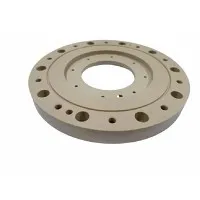
As a lathe machining nylon supplier, we have extensive experience in machining a variety of nylon products. Some examples of machined nylon products include bushings, bearings, gears, rollers, pulleys, and custom-made components. These products are used in a wide range of industries, including automotive, aerospace, electronics, and manufacturing.
For example, in the automotive industry, nylon bushings and bearings are commonly used to reduce friction and wear in engine components, suspension systems, and steering mechanisms. Nylon gears and pulleys are also used in automotive applications, as they offer high strength, low noise, and excellent resistance to wear and fatigue.
In the aerospace industry, nylon components are used in a variety of applications, including aircraft interiors, avionics, and flight control systems. Nylon's lightweight, high strength, and chemical resistance make it an ideal choice for these applications, where weight reduction and reliability are critical.
In the electronics industry, nylon components are used in a variety of applications, including connectors, switches, and housings. Nylon's electrical insulation properties and high strength make it an excellent choice for these applications, where electrical performance and durability are important.


Conclusion
In conclusion, the toughness of nylon has a significant impact on lathe machining. While its high strength, abrasion resistance, and energy absorption properties offer many advantages, they also present some challenges. By understanding these challenges and employing the right strategies, it's possible to achieve excellent results when machining tough nylon.
At our company, we specialize in lathe machining nylon products, and we have the expertise and experience to meet your specific requirements. Whether you need custom-made components or high-volume production, we can provide you with high-quality nylon products that are precision-machined to your exact specifications.
If you're interested in learning more about our lathe machining services or would like to discuss your nylon machining needs, please don't hesitate to [reach out to us for a consultation]. We look forward to working with you to provide the best solutions for your business.
References
- "Plastic Machining Handbook" by Robert A. Katz
- "Machining of Engineering Materials" by P.K. Wright and D.A. Boothroyd
- "CNC Machining: Principles and Programming" by Tony Scarborough