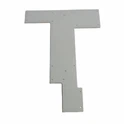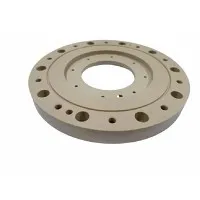

As a long - time supplier in the field of Milling machining Peek, I've witnessed firsthand the intricacies and challenges that come with this specialized process. One factor that significantly influences the outcome of milling machining Peek is the cutting depth. In this blog, I'll delve into the impact of cutting depth on milling machining Peek, sharing insights based on years of experience and industry knowledge.
Understanding Peek and Milling Machining
Peek, or Polyether Ether Ketone, is a high - performance engineering thermoplastic known for its exceptional mechanical properties, chemical resistance, and heat resistance. These characteristics make it a popular choice in various industries, including aerospace, automotive, medical, and electronics. Milling machining is a subtractive manufacturing process used to create custom - shaped parts from Peek materials. It involves using a rotating cutter to remove material from a workpiece to achieve the desired shape and dimensions.
The Role of Cutting Depth in Milling Machining
Cutting depth, often referred to as the depth of cut (DOC), is the distance that the cutting tool penetrates into the workpiece during each pass. It is a crucial parameter in milling machining as it directly affects the material removal rate, surface finish, tool life, and overall machining efficiency.
Material Removal Rate
The material removal rate (MRR) is a measure of how much material is removed from the workpiece per unit of time. A larger cutting depth generally leads to a higher MRR because more material is being removed with each pass of the cutting tool. For example, if we increase the cutting depth from 0.5 mm to 1 mm, assuming all other parameters remain constant, we can expect approximately double the amount of material to be removed in each pass. This can be advantageous when large amounts of material need to be removed quickly, such as in rough machining operations. However, increasing the cutting depth too much can also lead to problems.
Surface Finish
The surface finish of the machined part is another important consideration. A smaller cutting depth typically results in a better surface finish. When the cutting depth is small, the cutting tool has less material to remove in each pass, which reduces the amount of stress and deformation on the workpiece surface. This leads to a smoother and more precise surface finish. On the other hand, a large cutting depth can cause more significant vibrations and chatter, resulting in a rougher surface finish. For applications where a high - quality surface finish is required, such as in medical implants or optical components, a smaller cutting depth may be necessary.
Tool Life
Tool life is a critical factor in milling machining, as it directly impacts the cost and efficiency of the process. The cutting depth has a significant influence on tool life. A larger cutting depth increases the cutting forces acting on the tool, which can lead to faster tool wear and breakage. The increased forces can cause the tool to experience more friction, heat, and mechanical stress, all of which contribute to tool degradation. To extend tool life, it is often necessary to optimize the cutting depth based on the tool material, geometry, and the properties of the Peek material being machined.
Machining Efficiency
Machining efficiency is a combination of factors, including material removal rate, surface finish, and tool life. Finding the optimal cutting depth is essential for maximizing machining efficiency. A balance must be struck between removing material quickly (high MRR) and maintaining a good surface finish and long tool life. For example, in some cases, a series of roughing passes with a larger cutting depth followed by finishing passes with a smaller cutting depth can be an effective strategy. This approach allows for efficient material removal during the roughing stage while ensuring a high - quality surface finish during the finishing stage.
Experimental Evidence and Case Studies
Over the years, we've conducted numerous experiments and worked on various projects to understand the impact of cutting depth on milling machining Peek. In one project, we were machining Peek components for an aerospace application. Initially, we used a relatively large cutting depth of 2 mm during the roughing stage to achieve a high material removal rate. However, we noticed that the surface finish was not satisfactory, and the tool life was shorter than expected. After some adjustments, we reduced the cutting depth to 1 mm during the roughing stage and then used a cutting depth of 0.2 mm for the finishing pass. This resulted in a significant improvement in the surface finish and an extended tool life, ultimately meeting the strict requirements of the aerospace industry.


In another experiment, we compared the machining performance of different cutting depths on Peek samples. We measured the material removal rate, surface roughness, and tool wear for cutting depths ranging from 0.2 mm to 3 mm. The results showed that the material removal rate increased with increasing cutting depth, but the surface roughness also increased. The tool wear was more severe at larger cutting depths, especially when the cutting depth exceeded 2 mm. Based on these results, we were able to recommend an optimal cutting depth range for different machining operations on Peek.
Factors Affecting the Optimal Cutting Depth
Determining the optimal cutting depth for milling machining Peek is not a one - size - fits - all approach. Several factors need to be considered:
Peek Material Properties
The specific grade and properties of the Peek material can influence the optimal cutting depth. For example, some Peek grades may be more brittle or have different hardness levels, which can affect how they respond to the cutting forces. Higher - strength Peek materials may require a smaller cutting depth to avoid excessive tool wear and workpiece damage.
Cutting Tool Geometry and Material
The geometry and material of the cutting tool play a crucial role in determining the optimal cutting depth. Tools with a larger cutting edge angle or a more robust design may be able to handle larger cutting depths. Additionally, the choice of tool material, such as carbide or high - speed steel, can also affect the cutting performance. Carbide tools, for example, are generally more wear - resistant and can tolerate higher cutting forces, allowing for larger cutting depths in some cases.
Machine Tool Capabilities
The capabilities of the machine tool, including its power, rigidity, and spindle speed, also need to be considered. A more powerful and rigid machine tool can handle larger cutting depths without experiencing excessive vibrations or loss of accuracy. The spindle speed can also affect the cutting performance, as a higher spindle speed may allow for a larger cutting depth while maintaining a good surface finish.
Conclusion and Call to Action
In conclusion, the cutting depth has a profound impact on milling machining Peek, affecting the material removal rate, surface finish, tool life, and overall machining efficiency. As a supplier of Milling machining Peek, we understand the importance of optimizing the cutting depth to meet the specific requirements of each project. By carefully considering the factors mentioned above and conducting thorough experiments, we can help our customers achieve the best possible results in their Peek machining operations.
If you're in need of high - quality Milling machining Peek services, we're here to assist you. Whether you're working on a small - scale prototype or a large - scale production project, our team of experts can provide you with customized solutions based on your specific needs. We also offer machining services for other plastics such as CNC Machining Nylon and CNC Machining Polycarbonate. To learn more about our CNC Machining PEEK capabilities and discuss your project requirements, please reach out to us. We look forward to the opportunity to work with you and help you achieve success in your machining projects.
References
- Smith, J. (2018). Machining of High - Performance Plastics. Springer.
- Jones, A. (2020). Advanced Manufacturing Processes for Engineering Thermoplastics. Elsevier.
- Brown, R. (2019). Cutting Tool Technology for Precision Machining. Wiley.