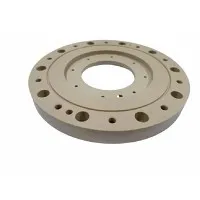

Hey there! As a supplier of Milling machining PPSU, I often get asked about the elastic modulus change of PPSU after milling. So, I thought I'd share some insights on this topic.
First off, let's talk a bit about PPSU. PPSU, or Polyphenylsulfone, is a high - performance thermoplastic. It's known for its excellent mechanical properties, chemical resistance, and high - temperature stability. These features make it a popular choice in various industries, like aerospace, medical, and automotive.
Now, what exactly is the elastic modulus? The elastic modulus, also called Young's modulus, is a measure of a material's stiffness. It shows how much a material will deform under a given load within its elastic range. In simple terms, a higher elastic modulus means the material is stiffer and less likely to bend or stretch when a force is applied.
When we mill PPSU, several factors can affect its elastic modulus. One of the main things is the heat generated during the milling process. Milling is a machining operation where we use cutting tools to remove material from the PPSU piece. This cutting action creates friction, and friction generates heat.
PPSU is a thermoplastic, and like other thermoplastics, its properties can be influenced by temperature. If the heat generated during milling gets too high, it can cause some changes in the molecular structure of PPSU. For example, the polymer chains in PPSU might start to break down a little bit. This can lead to a reduction in the material's stiffness, and thus, a decrease in the elastic modulus.
Another factor is the cutting speed and feed rate. If we mill PPSU at a very high cutting speed, the cutting forces can be quite large. These large forces can cause micro - cracks to form on the surface of the PPSU. These micro - cracks act as stress concentrators. When a load is applied later, the material is more likely to deform around these cracks, which can also result in a lower elastic modulus.
On the other hand, if the feed rate is too low, the cutting tool might rub against the PPSU for a longer time. This extended rubbing can also generate more heat and cause similar problems as high - speed milling.
We've done a bunch of tests in our workshop to study the elastic modulus change of PPSU after milling. In one set of tests, we milled PPSU samples using different cutting speeds and feed rates. We then measured the elastic modulus of the milled samples using a universal testing machine.
The results were quite interesting. When we used a moderate cutting speed and feed rate, the change in the elastic modulus was relatively small. The PPSU samples still retained most of their original stiffness. But when we increased the cutting speed significantly, we noticed a more substantial drop in the elastic modulus.
Let me give you an example. We had a PPSU sample with an original elastic modulus of around 2.5 GPa. After high - speed milling, the elastic modulus dropped to about 2.2 GPa. That's a noticeable decrease, and it can have an impact on the performance of the final product.
Now, why does this matter? Well, in applications where the stiffness of the material is crucial, like in aerospace components or precision medical devices, any change in the elastic modulus can affect the functionality of the part. For instance, if a PPSU component in an aircraft is supposed to have a certain stiffness to withstand aerodynamic forces, a decrease in the elastic modulus might make the component less reliable.
As a supplier of Milling machining PPSU, we take these factors very seriously. We've developed some best - practice guidelines for milling PPSU to minimize the change in the elastic modulus. For example, we use coolant during the milling process. The coolant helps to dissipate the heat generated by the cutting action. This keeps the temperature of the PPSU within a safe range and reduces the risk of molecular structure changes.
We also carefully select the cutting tools. High - quality cutting tools with sharp edges can reduce the cutting forces and the amount of heat generated. We use tools made from materials like carbide, which are very hard and can cut through PPSU efficiently.
In addition to PPSU, we also offer other CNC machining services. If you're interested in CNC Machining POM, CNC Machining FR4 G10, or CNC Machining PEEK, we've got you covered. These materials also have their own unique properties and machining requirements, and we have the expertise to handle them all.
If you're in the market for milled PPSU parts or any of our other CNC - machined plastic products, we'd love to have a chat with you. Whether you're a small - scale manufacturer or a large - scale industrial company, we can work with you to meet your specific needs. Our team of experts can help you optimize the milling process to ensure that the elastic modulus of your PPSU parts stays as close to the original value as possible.


So, don't hesitate to reach out to us for more information or to start a procurement discussion. We're here to provide you with high - quality milled PPSU parts and excellent customer service.
References
- "Engineering Plastics: Properties and Applications" by Donald V. Rosato
- "Machining of Polymers" - A research paper from a leading materials science journal