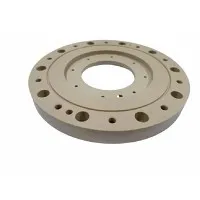

Hey there! I'm a supplier in the milling machining of PPSU (Polyphenylsulfone). Today, I'm super stoked to chat with you about how cutting speed affects the surface integrity of PPSU.
First off, let's quickly understand what PPSU is. It's a high - performance thermoplastic that's got some amazing properties. It's strong, heat - resistant, and has great chemical resistance. That's why it's used in a bunch of industries, like aerospace, medical, and automotive. And as a milling machining PPSU supplier, I deal with this awesome material on a daily basis.
Now, cutting speed is a big deal in the machining process. It's basically how fast the cutting tool moves relative to the workpiece. When we're talking about PPSU, the cutting speed can have a huge impact on the surface integrity of the final product.
Let's start with the good side of a proper cutting speed. When we set the right cutting speed for PPSU, we can achieve a smooth surface finish. A smooth surface is not just about looking good; it's crucial for the functionality of the part. For example, in medical devices made from PPSU, a smooth surface reduces the risk of bacterial adhesion. And in aerospace applications, a smooth surface can improve aerodynamics.
When we choose an appropriate cutting speed, the chips produced during the milling process are also removed more efficiently. This prevents the chips from getting stuck between the cutting tool and the workpiece, which could otherwise cause scratches or other surface defects. So, in a way, the right cutting speed helps in maintaining the overall quality of the PPSU part.
But what happens when the cutting speed is too high? Well, things can get a bit messy. High cutting speeds generate a lot of heat. PPSU, like any other thermoplastic, is sensitive to heat. Excessive heat can cause the material to melt or deform locally. This leads to a rough surface finish, with unevenness and even some charring in extreme cases.


Moreover, high - speed cutting can cause the cutting tool to wear out faster. As the tool wears, it loses its sharpness, and this can also degrade the surface quality of the PPSU. The tool may start to tear the material instead of cutting it cleanly, leaving behind rough edges and ridges.
On the flip side, if the cutting speed is too low, the machining process becomes inefficient. It takes longer to complete the part, and this can increase the production cost. Also, a low cutting speed can result in built - up edge formation. This is when small bits of the PPSU material stick to the cutting tool, which then transfer onto the workpiece surface, creating a poor surface finish.
So, how do we find the optimal cutting speed for PPSU? Well, it depends on a few factors. The type of cutting tool used is one of them. Different tools have different capabilities and are designed for specific cutting speeds. For example, carbide tools can generally handle higher cutting speeds compared to high - speed steel tools.
The geometry of the part also matters. Complex shapes may require a more conservative cutting speed to ensure that all areas of the part are machined accurately. And of course, the specific grade of PPSU plays a role. Some grades of PPSU may have different heat - resistance properties, which will affect the ideal cutting speed.
As a milling machining PPSU supplier, I've had my fair share of experiences in finding the right cutting speed. It often involves a bit of trial and error. We start with some recommended values based on industry standards and then make adjustments based on the actual results. Sometimes, we use advanced monitoring systems to measure the temperature and cutting forces during the machining process, which helps us fine - tune the cutting speed.
Now, if you're in the market for CNC machining of various plastics, you might be interested in some related options. Check out CNC Machining ABS and CNC Machining PEEK. And of course, if you're specifically looking for CNC Machining PPSU, we've got you covered.
We've got the expertise and the equipment to ensure that we can machine PPSU parts with the best surface integrity possible. Whether you need a small batch for prototyping or a large - scale production run, we're here to help.
If you're interested in discussing your PPSU machining needs, don't hesitate to reach out. We can have a chat about your specific requirements, and I'm sure we can come up with a solution that meets your expectations.
In conclusion, the cutting speed has a profound effect on the surface integrity of PPSU. It's a delicate balance that needs to be struck to achieve the best results. As a supplier, we're constantly working on improving our processes to ensure that we deliver high - quality PPSU parts every time.
References
- Smith, J. (2018). "Machining of Thermoplastics: A Review". Journal of Manufacturing Science.
- Brown, A. (2020). "Optimizing Cutting Parameters for High - Performance Plastics". International Journal of Precision Engineering.