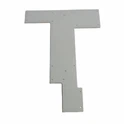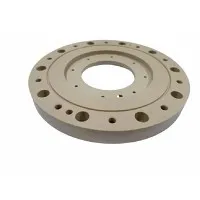

Hey there! I'm a supplier of Milling machining PPSU, and today I want to talk about an interesting question: What is the density change of PPSU after milling?
Let's start with a little background on PPSU. PPSU, or polyphenylsulfone, is a high - performance thermoplastic. It's known for its excellent heat resistance, high mechanical strength, and good chemical stability. These properties make it a top choice in a whole bunch of industries, like aerospace, medical, and food processing.


Now, when it comes to milling PPSU, it's a machining process where we use cutting tools to remove material from a PPSU workpiece to get the desired shape. But here's the thing: does this milling process change the density of PPSU?
The Basics of Density
First off, density is defined as the mass of a substance per unit volume, which we usually express as grams per cubic centimeter (g/cm³). For PPSU, its density typically ranges from about 1.29 - 1.35 g/cm³ in its original, unmachined state. This value can vary slightly depending on factors such as the specific grade of PPSU and the manufacturing conditions during its production.
Factors Affecting Density Change During Milling
1. Material Removal
When we mill PPSU, we're essentially taking away small bits of the material. At a first glance, you might think that removing material would change the density. However, the density of the remaining PPSU doesn't change because density is an intrinsic property of the material itself. The material that's removed has the same density as the material that's left behind. So, in theory, just the act of removing material through milling doesn't cause a change in the density of the PPSU workpiece.
2. Heat Generation
One of the big things that happens during milling is the generation of heat. The friction between the cutting tool and the PPSU can get pretty intense, and this heat can have an impact on the material. PPSU has a certain coefficient of thermal expansion, which means it expands when heated and contracts when cooled.
If the heat generated during milling is very high, the PPSU might expand during the process. When it expands, the volume increases while the mass stays the same. According to the density formula (density = mass/volume), an increase in volume with constant mass leads to a decrease in density. But once the PPSU cools down to room temperature, it will contract back to its original state (or close to it), and the density will return to its normal value.
3. Micro - Structural Changes
Milling can also cause some micro - structural changes in the PPSU. The high - speed cutting and mechanical forces involved might introduce small internal stresses or change the orientation of the polymer chains in the material. In some cases, these micro - structural changes could potentially affect the packing of the polymer chains, which in turn might have a very slight impact on the density. But these changes are usually extremely minor and might be difficult to measure accurately.
Measuring the Density Change
To figure out if there's a density change in PPSU after milling, we can use a few different methods.
Archimedes' Principle
This is a classic method for measuring density. We first weigh the PPSU workpiece before milling. Then we submerge it in a liquid (usually water) and measure the volume of the liquid displaced. The density is then calculated as the mass divided by the volume. After milling, we repeat the process. By comparing the pre - and post - milling density values, we can see if there's any change.
Gas Pycnometry
This is a more advanced technique. Gas pycnometry measures the volume of a sample by using a gas (usually helium). The sample is placed in a chamber, and the gas is allowed to fill the chamber. By measuring the pressure changes, we can accurately determine the volume of the sample. Combining this with the mass measurement, we can calculate the density.
Practical Implications
For us as a Milling machining PPSU supplier, understanding the density change (or lack thereof) is really important. In industries where tight tolerances are crucial, like aerospace, even small changes in density could affect the performance of the final product. For example, if a part has a different density than expected, it might have different mechanical properties or could cause balance issues in a larger assembly.
On the other hand, in less critical applications, a slight change in density might not be a big deal. But it's still good to know about it so that we can provide accurate information to our customers.
Other Related CNC Machining Processes
By the way, we also offer other CNC machining services. If you're interested in CNC machining of different plastics, check out these links:
- CNC Machining Nylon: Nylon is another popular engineering plastic, and we have the expertise to machine it to your exact specifications.
- CNC Machining ABS: ABS is widely used in consumer products, and our CNC machining can ensure high - quality parts.
- CNC Machining PMI Foams and PVC: These materials have unique properties, and we're well - equipped to handle their machining needs.
Let's Talk Business!
If you're in the market for milled PPSU parts or have any questions about our CNC machining services, don't hesitate to reach out. We're here to provide you with the best - quality products and services to meet your specific requirements. Whether you need a small batch for prototyping or a large - scale production run, we've got you covered.
References
- Polymers for High - Performance Engineering Applications. Author: Various polymer experts. Publisher: Academic Press.
- Handbook of Plastics Materials and Technology. Author: Irvin I. Rubin. Publisher: Wiley.