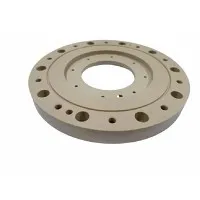

As a supplier specializing in CNC machining of PPSU (Polyphenylsulfone) parts, I've witnessed firsthand the importance of proper storage conditions for these high - performance components. PPSU is a high - temperature engineering thermoplastic known for its excellent mechanical properties, chemical resistance, and transparency. However, to maintain the quality and performance of CNC machined PPSU parts, it's crucial to store them under appropriate conditions.
Temperature Considerations
One of the most critical factors in storing CNC machined PPSU parts is temperature. PPSU has a high glass transition temperature (Tg) of around 207°C, which means it retains its mechanical properties at relatively high temperatures. However, extreme temperature fluctuations can still have a negative impact on the parts.
For long - term storage, it's recommended to keep PPSU parts in an environment with a stable temperature. A temperature range between 10°C and 30°C is ideal. Temperatures below this range can make the material more brittle, increasing the risk of cracking during handling. On the other hand, temperatures above 30°C for an extended period can cause the material to gradually soften and lose its dimensional stability.
In industrial settings, it's common to use climate - controlled storage facilities. These facilities are equipped with heating and cooling systems to maintain a constant temperature. If such facilities are not available, simple measures like storing the parts away from direct sunlight and heat sources can help. For example, avoid placing the parts near radiators, ovens, or in areas where they will be exposed to direct sunlight through windows.
Humidity Control
Humidity is another factor that can affect the quality of CNC machined PPSU parts. PPSU has a certain degree of moisture absorption. Although it is less hygroscopic compared to some other plastics, excessive moisture can still lead to issues.
High humidity can cause the PPSU parts to absorb water, which may result in dimensional changes and a decrease in mechanical properties. When the parts absorb moisture, they can swell slightly, leading to inaccurate dimensions. This is particularly problematic for parts that require high precision.
To control humidity, it's advisable to store PPSU parts in a dry environment. A relative humidity level of 30% - 50% is considered optimal. In areas with high humidity, dehumidifiers can be used to reduce the moisture content in the air. Additionally, storing the parts in sealed containers with desiccants can help absorb any moisture that may enter the container.
Protection from Chemicals and Contaminants
PPSU is known for its good chemical resistance, but it's still vulnerable to certain chemicals. When storing CNC machined PPSU parts, it's essential to keep them away from chemicals that can cause damage.
Strong solvents, such as acetone, methyl ethyl ketone (MEK), and some halogenated hydrocarbons, can dissolve or swell PPSU. Therefore, avoid storing the parts in areas where these chemicals are used or stored. In addition, contaminants like dust, dirt, and grease can also affect the surface finish and performance of the parts.
To protect the parts from contaminants, it's a good practice to store them in clean, closed containers. If the parts are large and cannot be stored in containers, they can be covered with protective sheets. Regular cleaning of the storage area can also help prevent the accumulation of dust and dirt.


Protection from Mechanical Damage
CNC machined PPSU parts are often precision - made, and any mechanical damage can render them useless. When storing these parts, it's important to protect them from impacts, scratches, and abrasions.
Stacking the parts carefully is crucial. Avoid stacking them too high or in a way that can cause pressure points. If possible, use dividers or padding between the parts to prevent them from rubbing against each other. For parts with delicate features, custom - made foam inserts can be used to hold them in place and provide cushioning.
In addition, handling the parts with care during storage and retrieval is essential. Use appropriate tools, such as soft - tipped tweezers or gloves, to avoid scratching the surface of the parts.
Comparison with Other CNC Machined Plastics
It's interesting to compare the storage conditions of CNC machined PPSU parts with other commonly machined plastics. For example, CNC Machining Polycarbonate has different storage requirements. Polycarbonate is more hygroscopic than PPSU, so it requires more strict humidity control. High humidity can cause polycarbonate to become cloudy and reduce its optical clarity.
CNC Machining PEEK is another high - performance plastic. PEEK has excellent chemical resistance and can withstand higher temperatures compared to PPSU. However, it is also more expensive. When storing PEEK parts, similar temperature and humidity control measures are required, but due to its higher heat resistance, it can tolerate slightly higher temperatures for short periods.
CNC Machining FR4 G10 is a fiberglass - reinforced epoxy laminate. It is less affected by temperature and humidity compared to thermoplastics like PPSU. However, it is more prone to mechanical damage due to its brittle nature. Therefore, protecting FR4 G10 parts from impacts is of utmost importance during storage.
Importance of Proper Storage for Quality Assurance
Proper storage of CNC machined PPSU parts is directly related to quality assurance. When the parts are stored under the right conditions, their mechanical properties, dimensional accuracy, and surface finish are maintained. This ensures that the parts will perform as expected when they are used in their intended applications.
For example, in the medical industry, PPSU parts are often used in surgical instruments and medical devices. Any change in the quality of these parts due to improper storage can have serious consequences for patient safety. In the aerospace industry, where precision and reliability are crucial, PPSU parts must be stored properly to meet the strict quality standards.
Conclusion
In conclusion, as a CNC machining PPSU supplier, I emphasize the importance of proper storage conditions for these high - performance parts. Temperature, humidity, protection from chemicals and contaminants, and prevention of mechanical damage are all key factors to consider. By following these guidelines, the quality and performance of CNC machined PPSU parts can be maintained, ensuring customer satisfaction.
If you are in need of high - quality CNC machined PPSU parts or have any questions about their storage and application, feel free to reach out to us for a discussion. We are committed to providing you with the best solutions and products.
References
- "Engineering Plastics Handbook" by Carl A. Harper
- Technical data sheets provided by PPSU material manufacturers
- Industry standards and guidelines for plastic part storage