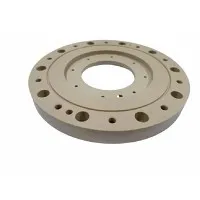
Hey there! As a supplier of machined POM (Polyoxymethylene) parts, I've seen firsthand the importance of getting the design right. POM, also known as acetal, is a high-performance engineering plastic with excellent mechanical properties, low friction, and good dimensional stability. But when it comes to machining POM parts, there are several design considerations that can make or break the final product. In this blog post, I'll share some key points to keep in mind when designing machined POM parts.
Material Properties
First off, let's talk about the material itself. POM has some unique properties that need to be considered during the design phase. It has a relatively high melting point, which means it can withstand higher temperatures compared to some other plastics. However, it's also sensitive to heat during machining. Excessive heat can cause the material to soften, leading to poor surface finish and dimensional inaccuracies.
Another important property is its low friction coefficient. This makes POM a great choice for parts that require smooth movement, like gears and bearings. But it also means that the material can be prone to chipping during machining, especially if the cutting tools aren't sharp enough.
Tolerances
Tolerances are a big deal when it comes to machined POM parts. POM has good dimensional stability, but achieving tight tolerances can still be a challenge. When designing your part, you need to be realistic about the tolerances you can achieve. Tighter tolerances generally mean higher costs, as they require more precise machining and quality control.
For example, if you're designing a part that needs to fit precisely with another component, you'll need to specify the appropriate tolerances. But if the part doesn't require such a high level of precision, you can relax the tolerances to save on costs. Keep in mind that the type of machining process you choose can also affect the achievable tolerances. For instance, CNC machining can generally achieve tighter tolerances compared to manual machining.
Wall Thickness
Wall thickness is another crucial design consideration. POM parts with uneven wall thickness can experience warping and stress concentrations during machining and cooling. To avoid these issues, try to keep the wall thickness as uniform as possible. If you need to have varying wall thicknesses, make sure to transition gradually between them.
A good rule of thumb is to keep the minimum wall thickness around 1 - 2 mm, depending on the size and complexity of the part. Thinner walls can be more difficult to machine and may be more prone to breakage, while thicker walls can increase the weight and cost of the part.
Fillets and Radii
Adding fillets and radii to your POM part design can significantly improve its strength and machinability. Sharp corners can create stress concentrations, which can lead to cracking and failure of the part. By adding fillets and radii, you can distribute the stress more evenly and reduce the risk of damage.
When choosing the size of the fillets and radii, consider the machining process and the tooling available. Smaller fillets and radii may require more precise tooling and can be more difficult to machine, while larger ones can be easier to produce but may affect the overall design of the part.
Surface Finish
The surface finish of a machined POM part can have a big impact on its performance. A smooth surface finish can reduce friction and wear, while a rough surface can cause problems like sticking and increased noise. When specifying the surface finish, think about the function of the part. For example, if the part is going to be in contact with other moving components, a smoother surface finish may be required.
The machining process can also affect the surface finish. CNC machining can generally achieve a better surface finish compared to other methods. However, post - machining processes like polishing can be used to further improve the surface quality if needed.
Undercuts and Holes
Undercuts and holes in POM parts need to be carefully designed. Undercuts can be challenging to machine, especially if they are deep or have complex shapes. They may require special tooling or machining techniques. When designing undercuts, make sure to consider the accessibility of the tool and the potential for tool breakage.
Holes also need to be designed with care. The diameter, depth, and location of the holes can all affect the machining process. For example, drilling deep holes in POM can be difficult due to the material's tendency to chip. It's important to use the right drill bits and cutting parameters to ensure clean and accurate holes.
Machining Process Selection
As a supplier of machined POM parts, I often get asked about the best machining process. There are several options available, including CNC machining, manual machining, and injection molding.
CNC machining is a popular choice for POM parts because it offers high precision, repeatability, and the ability to produce complex shapes. It's suitable for both small - batch and large - batch production. You can learn more about CNC machining of different plastics like CNC Machining PMMA, CNC Machining PEEK, and CNC Machining Polycarbonate on our website.
Manual machining can be a cost - effective option for simple parts or small - scale production. However, it may not offer the same level of precision and repeatability as CNC machining.
Injection molding is a good choice for large - volume production of POM parts. It can produce parts with high efficiency and consistent quality. But it requires expensive tooling, so it's not suitable for small - batch production.
Assembly and Joining
If your POM part needs to be assembled with other components, you need to consider the assembly and joining methods. There are several ways to join POM parts, including adhesives, mechanical fasteners, and welding.


Adhesives can provide a strong bond, but you need to choose the right adhesive that is compatible with POM. Mechanical fasteners like screws and bolts are easy to use but may require additional holes and can add weight to the part. Welding can be a good option for joining POM parts, but it requires specialized equipment and skills.
Cost Considerations
Cost is always a factor in any design project. When designing machined POM parts, you need to balance the performance requirements with the cost. As I mentioned earlier, tighter tolerances, more complex shapes, and better surface finishes generally mean higher costs.
You can save on costs by simplifying the design, using standard sizes and shapes, and choosing the most cost - effective machining process. For example, if the part doesn't require high precision, you can choose a less expensive machining method.
Conclusion
Designing machined POM parts requires careful consideration of many factors, from material properties and tolerances to machining processes and cost. By keeping these design considerations in mind, you can ensure that your POM parts are of high quality, perform well, and are cost - effective.
If you're in the market for machined POM parts, I'd love to have a chat with you. Whether you have a specific design in mind or need some advice on the best way to design your part, I'm here to help. Just reach out and let's start the conversation about your project.
References
- "Engineering Plastics Handbook"
- "Machining of Plastics: Principles and Applications"