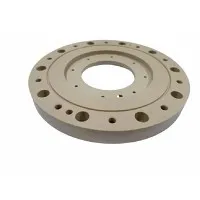

Hey there! I'm a supplier of CNC Machining FR4 G10, and today I'm gonna chat about the acoustic properties of this awesome material.

First off, let's understand what FR4 G10 is. It's a composite material made of fiberglass cloth and epoxy resin. And when it comes to CNC machining, it's a popular choice because it can be precisely cut and shaped to meet various design requirements.

Now, onto the acoustic properties. Acoustic properties refer to how a material interacts with sound waves. This includes things like sound absorption, sound transmission, and sound reflection.
Sound Absorption
Sound absorption is a key property, especially in environments where you want to reduce noise. FR4 G10 has a certain level of sound - absorbing ability. The fiberglass cloth in the material plays a crucial role here. Fiberglass has a porous structure, and when sound waves hit the surface of FR4 G10, they enter these pores. As the sound waves travel through the pores, they encounter resistance from the fiberglass fibers and the epoxy resin. This resistance causes the sound energy to be converted into heat energy, which in turn reduces the intensity of the sound.
The degree of sound absorption depends on several factors. One of them is the thickness of the FR4 G10. Thicker sheets generally absorb more sound because the sound waves have a longer path to travel through the material, allowing for more energy conversion. Another factor is the density of the fiberglass cloth. A denser cloth may have smaller pores, which can lead to different absorption characteristics. For example, a denser structure might be more effective at absorbing high - frequency sounds, while a less dense one could work better for lower - frequency sounds.
Sound Transmission
Sound transmission is about how much sound passes through a material. FR4 G10 has relatively low sound transmission compared to some other materials. The combination of fiberglass and epoxy resin creates a barrier that restricts the passage of sound waves. The epoxy resin acts as a binder, holding the fiberglass cloth together and adding to the overall stiffness of the material. This stiffness helps in reducing the vibration that would otherwise allow sound to pass through easily.
However, it's important to note that the sound transmission also depends on the construction and installation of the FR4 G10 component. If there are gaps or joints in a structure made of FR4 G10, sound can leak through these areas. So, proper sealing and installation are essential to minimize sound transmission.
Sound Reflection
Sound reflection occurs when sound waves bounce off the surface of a material. FR4 G10 has a somewhat moderate level of sound reflection. The smoothness of the surface affects the reflection. A well - machined FR4 G10 surface with a high level of smoothness will reflect sound more efficiently than a rough surface. When sound waves hit a smooth surface, they tend to bounce off at an angle according to the law of reflection.

In some applications, sound reflection can be both an advantage and a disadvantage. For example, in a sound - proofing room, too much reflection can cause echoes, which are undesirable. But in some acoustic devices, a certain amount of reflection can be used to direct sound in a specific direction.
Comparison with Other Materials
Let's compare FR4 G10 with some other materials commonly used in CNC machining, like CNC Machining Nylon and CNC Machining ABS.

Nylon is a thermoplastic material. It has different acoustic properties compared to FR4 G10. Nylon is generally more flexible than FR4 G10, and this flexibility can affect its sound - related performance. It may have a different level of sound absorption and transmission. Nylon can absorb some sound, but its porous structure is not as well - defined as that of FR4 G10, so its sound - absorbing efficiency might be different.
ABS is another popular material in CNC machining. It's known for its good mechanical properties and ease of machining. However, in terms of acoustic properties, ABS has a relatively high sound transmission rate compared to FR4 G10. ABS is a more homogeneous material, and it doesn't have the same porous structure as FR4 G10, which makes it less effective at absorbing and blocking sound.
Applications Based on Acoustic Properties
The unique acoustic properties of FR4 G10 make it suitable for a variety of applications.
In the audio industry, it can be used in the construction of speaker enclosures. The sound - absorbing and low - transmission properties of FR4 G10 can help in reducing unwanted external noise from entering the enclosure and also prevent internal sound from leaking out. This results in a cleaner and more focused sound output from the speakers.
In the automotive industry, FR4 G10 can be used in parts where noise reduction is important. For example, it can be used in engine compartments to reduce the transmission of engine noise to the passenger cabin.
In the aerospace industry, where weight and acoustic performance are both critical, FR4 G10 can be used in interior panels. Its relatively low weight combined with good acoustic properties makes it an attractive option for reducing noise levels inside the aircraft.
Quality Control in CNC Machining for Acoustic Performance
As a supplier of CNC Machining FR4 G10, I pay close attention to quality control to ensure that the acoustic properties of the machined parts meet the desired standards.
During the CNC machining process, the cutting parameters need to be carefully adjusted. If the cutting speed is too high, it can cause damage to the surface of the FR4 G10, which may affect its acoustic performance. For example, a rough surface due to improper cutting can change the sound reflection characteristics.
We also conduct various tests on the machined parts. One of the common tests is the sound absorption coefficient test. This test measures how much sound is absorbed by the material at different frequencies. By analyzing the results of these tests, we can make adjustments to the machining process or the material composition if necessary.
Conclusion
In conclusion, the acoustic properties of CNC machined FR4 G10 are quite unique and offer many advantages in different industries. Its sound - absorbing, low - transmission, and moderate - reflection characteristics make it a versatile material for applications where noise control is important.
If you're in need of high - quality CNC Machined FR4 G10 parts with excellent acoustic properties, don't hesitate to reach out for a procurement discussion. We can work together to find the best solutions for your specific needs.
References
- "Handbook of Composite Materials" by John Summerscales
- "Acoustics: An Introduction" by Malcolm J. Crocker