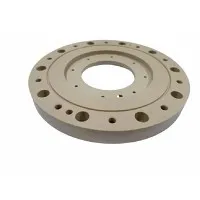

Hey there! I'm a supplier in the business of milling machining Peek. Peek, or Polyether Ether Ketone, is a high-performance thermoplastic known for its excellent mechanical properties, chemical resistance, and thermal stability. It's widely used in various industries, including aerospace, medical, and automotive. But when it comes to milling Peek, optimizing the tool path is crucial for achieving the best results. In this blog, I'll share some tips on how to do just that.
Understanding the Basics of Peek Milling
Before we dive into tool path optimization, let's quickly go over some basics of milling Peek. Peek is a tough material, and it can generate a lot of heat during the machining process. This heat can cause the material to soften, warp, or even melt, leading to poor surface finish and dimensional accuracy. That's why it's important to use the right cutting tools, cutting parameters, and coolant to keep the temperature under control.
Choosing the Right Cutting Tools
The first step in optimizing the tool path for milling Peek is to choose the right cutting tools. High-speed steel (HSS) tools are a good choice for roughing operations, but for finishing operations, carbide tools are preferred. Carbide tools are harder and more wear-resistant than HSS tools, which means they can maintain their sharpness for longer periods of time. This results in better surface finish and longer tool life.
When selecting carbide tools, look for tools with a high helix angle and a large rake angle. The high helix angle helps to evacuate chips more efficiently, while the large rake angle reduces cutting forces and heat generation. Also, make sure to choose tools with a sharp cutting edge and a good chip breaker to prevent chip buildup and improve chip evacuation.
Determining the Optimal Cutting Parameters
Once you've chosen the right cutting tools, the next step is to determine the optimal cutting parameters. The cutting parameters include cutting speed, feed rate, and depth of cut. These parameters depend on several factors, such as the type of cutting tool, the material being machined, and the desired surface finish.
For milling Peek, a cutting speed of 100-200 m/min is recommended for roughing operations, and 200-300 m/min for finishing operations. The feed rate should be between 0.1-0.2 mm/tooth for roughing and 0.05-0.1 mm/tooth for finishing. The depth of cut should be kept between 0.5-2 mm for roughing and 0.1-0.5 mm for finishing.
It's important to note that these are just general guidelines, and you may need to adjust the cutting parameters based on your specific machining conditions. You can use a cutting data calculator or consult with your tool supplier to determine the optimal cutting parameters for your application.
Optimizing the Tool Path
Now that you've chosen the right cutting tools and determined the optimal cutting parameters, it's time to optimize the tool path. The tool path is the path that the cutting tool follows during the machining process. A well-optimized tool path can reduce cutting time, improve surface finish, and extend tool life.
Here are some tips on how to optimize the tool path for milling Peek:
- Use a climb milling strategy: Climb milling is a milling strategy where the cutting tool rotates in the same direction as the feed. This results in a cleaner cut and less tool wear compared to conventional milling, where the cutting tool rotates in the opposite direction of the feed.
- Minimize the number of tool retractions: Tool retractions are the movements of the cutting tool out of the workpiece. Each tool retraction adds to the machining time and can cause tool wear. To minimize the number of tool retractions, use a continuous tool path and avoid unnecessary stops and starts.
- Use a trochoidal milling strategy: Trochoidal milling is a milling strategy where the cutting tool follows a circular path while moving along the workpiece. This results in a more efficient use of the cutting tool and reduces cutting forces and heat generation.
- Optimize the entry and exit paths: The entry and exit paths of the cutting tool can have a significant impact on the surface finish and tool life. To optimize the entry and exit paths, use a ramp entry and exit strategy, where the cutting tool gradually enters and exits the workpiece at a shallow angle.
Using Coolant
As mentioned earlier, Peek generates a lot of heat during the machining process. To keep the temperature under control, it's important to use coolant. Coolant helps to reduce cutting forces, improve surface finish, and extend tool life.


There are several types of coolant available, including water-based coolant, oil-based coolant, and synthetic coolant. Water-based coolant is the most commonly used type of coolant because it's inexpensive and environmentally friendly. However, oil-based coolant and synthetic coolant are better suited for high-speed machining operations and for machining materials that generate a lot of heat, such as Peek.
When using coolant, make sure to apply it directly to the cutting zone. This will help to cool the cutting tool and the workpiece and prevent chip buildup. Also, make sure to use the right concentration of coolant to ensure optimal performance.
Conclusion
Optimizing the tool path for milling Peek is crucial for achieving the best results. By choosing the right cutting tools, determining the optimal cutting parameters, optimizing the tool path, and using coolant, you can reduce cutting time, improve surface finish, and extend tool life.
If you're interested in learning more about CNC machining of other materials, check out these links: CNC Machining ABS, CNC Machining FR4 G10, and CNC Machining PMI Foams and PVC.
If you're in the market for milling machining Peek services, feel free to reach out to us. We're a leading supplier of milling machining Peek, and we have the expertise and experience to meet your needs. Contact us today to discuss your project and get a quote.
References
- "Machining of Engineering Plastics" by John A. Schey
- "CNC Machining Handbook" by Peter Smid