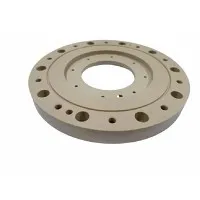

Optimizing the cutting parameters for CNC machining POM (Polyoxymethylene) is crucial for achieving high-quality parts, maximizing efficiency, and reducing costs. As a CNC machining POM supplier, I've had extensive experience in this area and would like to share some insights on how to optimize these cutting parameters.
Understanding POM
POM, also known as acetal or Delrin, is a high-performance engineering thermoplastic. It has excellent mechanical properties, including high stiffness, low friction, and good dimensional stability. However, it also has some characteristics that need to be considered during CNC machining. For example, POM has a relatively low melting point, which means it can easily melt if the cutting temperature is too high. It also has a tendency to produce chips that can adhere to the cutting tool, leading to poor surface finish and tool wear.
Key Cutting Parameters
There are several key cutting parameters that need to be optimized for CNC machining POM:
Cutting Speed
The cutting speed refers to the speed at which the cutting tool moves relative to the workpiece. A higher cutting speed generally leads to higher productivity, but it can also increase the cutting temperature and tool wear. For POM, a moderate cutting speed is usually recommended to avoid overheating. The optimal cutting speed depends on various factors such as the tool material, tool geometry, and the specific grade of POM. For example, when using a carbide cutting tool, a cutting speed in the range of 80 - 150 m/min is often a good starting point.
Feed Rate
The feed rate is the distance the cutting tool advances into the workpiece per revolution or per tooth. A higher feed rate can increase the material removal rate, but it may also result in a poor surface finish and increased cutting forces. When machining POM, a relatively low to moderate feed rate is typically preferred to ensure good chip formation and surface quality. A feed rate of 0.05 - 0.2 mm/tooth is commonly used, depending on the cutting tool and the machining operation.


Depth of Cut
The depth of cut is the thickness of the layer of material removed in a single pass. A larger depth of cut can reduce the number of passes required, but it also increases the cutting forces and the risk of tool breakage. For POM, a small to moderate depth of cut is usually recommended. A depth of cut of 0.5 - 2 mm is often suitable, depending on the tool diameter and the workpiece geometry.
Tool Selection
The choice of cutting tool is also critical for optimizing the cutting parameters for CNC machining POM. Carbide cutting tools are commonly used due to their high hardness and wear resistance. Coated carbide tools can further improve the tool life and cutting performance. The tool geometry, such as the rake angle, clearance angle, and cutting edge radius, also affects the cutting process. For POM, a sharp cutting edge with a positive rake angle is often preferred to reduce the cutting forces and improve chip formation.
Cooling and Lubrication
Proper cooling and lubrication can significantly improve the cutting performance and tool life when machining POM. Since POM has a low melting point, it is important to keep the cutting temperature under control. Using a coolant or lubricant can help dissipate the heat generated during cutting and reduce friction between the tool and the workpiece. Water-soluble coolants are commonly used for CNC machining POM. They can also help flush away the chips and prevent them from adhering to the tool.
Testing and Optimization
Optimizing the cutting parameters for CNC machining POM is often an iterative process. It is recommended to conduct test cuts on a sample workpiece to evaluate the cutting performance and surface quality. By adjusting the cutting speed, feed rate, depth of cut, and other parameters, you can find the optimal combination for your specific machining requirements. You can also use advanced machining simulation software to predict the cutting forces, temperature distribution, and chip formation, which can help you optimize the cutting parameters more efficiently.
Case Study
Let's take a look at a real - world case study. A customer came to us with a requirement to machine a complex POM part with high precision and a good surface finish. Initially, we used a set of standard cutting parameters based on our experience. However, the surface finish was not satisfactory, and the tool wear was relatively high. We then conducted a series of test cuts, gradually adjusting the cutting speed, feed rate, and depth of cut. We also changed the cutting tool to a coated carbide tool with a more suitable geometry. After several rounds of optimization, we were able to achieve the desired surface finish and significantly reduce the tool wear. The production efficiency was also improved by about 20%.
Other Related CNC Machining Services
In addition to CNC machining POM, we also offer other high - quality CNC machining services, such as CNC Machining PPSU, CNC Machining PMI Foams and PVC, and CNC Machining FR4 G10. These materials have their own unique properties and require different cutting parameters and machining techniques. Our experienced team can provide customized solutions to meet your specific needs.
Conclusion
Optimizing the cutting parameters for CNC machining POM requires a comprehensive understanding of the material properties, tool selection, and cutting process. By carefully adjusting the cutting speed, feed rate, depth of cut, and using the right cutting tools and cooling methods, you can achieve high - quality parts, improve productivity, and reduce costs. If you are looking for a reliable CNC machining POM supplier, we are here to help. We have the expertise and experience to provide you with the best solutions for your machining needs. Contact us for more information and let's start a successful partnership.
References
- "Machining of Engineering Materials" by Peter Kalpakjian and Steven R. Schmid
- "CNC Machining Handbook" by various industry experts