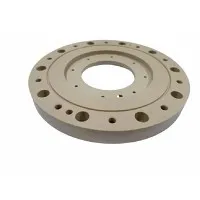

Hey there! I'm a supplier in the business of CNC machining PPSU, and I know how crucial accuracy is in this field. In this blog, I'll share some tips on how to improve the accuracy of CNC machining PPSU.
First off, let's understand what PPSU is. Polyphenylsulfone (PPSU) is a high - performance thermoplastic known for its excellent heat resistance, chemical resistance, and mechanical properties. It's widely used in aerospace, medical, and food - contact applications. But machining it accurately can be a bit of a challenge.
1. Select the Right Tools
The choice of cutting tools is super important. For PPSU, carbide tools are often a great option. They're hard, wear - resistant, and can handle the high - speed cutting that CNC machines are capable of. When selecting tools, pay attention to the geometry. For example, tools with sharp cutting edges can reduce the cutting force, which in turn helps to improve accuracy. A tool with a proper rake angle and clearance angle can prevent the material from sticking to the tool and ensure a smooth cutting process.
Another thing to consider is the tool coating. Some coatings, like titanium nitride (TiN), can increase the tool's hardness and reduce friction. This means less wear on the tool and more consistent cutting performance, leading to better accuracy.
2. Optimize the Cutting Parameters
Cutting speed, feed rate, and depth of cut are the three main cutting parameters that you need to get right. The cutting speed is how fast the tool moves relative to the workpiece. For PPSU, a moderate cutting speed is usually recommended. Too high a speed can generate excessive heat, which may cause the PPSU to melt or deform, affecting the accuracy of the machining.
The feed rate is how fast the workpiece moves towards the tool. A proper feed rate ensures that the tool cuts through the material evenly. If the feed rate is too high, the tool may not be able to remove the material effectively, resulting in rough surfaces and inaccurate dimensions. On the other hand, if the feed rate is too low, it can be time - consuming and may also cause the tool to wear out faster.
The depth of cut determines how much material is removed in each pass. A smaller depth of cut can reduce the cutting force and the risk of vibration, which is beneficial for accuracy. However, if the depth of cut is too small, it may increase the number of passes required, thus increasing the machining time.
3. Ensure Proper Workholding
Workholding is often overlooked, but it's essential for accurate CNC machining. When machining PPSU, you need to hold the workpiece firmly and securely. A loose workpiece can move during the machining process, leading to dimensional errors.
There are different types of workholding devices, such as vises, clamps, and fixtures. For PPSU, you may need to use soft - jaw vises to prevent damage to the workpiece. Make sure the workholding device is properly aligned with the machine's axes. Any misalignment can cause the workpiece to be machined at an incorrect angle, affecting the overall accuracy.
4. Control the Temperature
As I mentioned earlier, heat can be a problem when machining PPSU. Excessive heat can cause the material to expand, warp, or even degrade. To control the temperature, you can use coolant or lubricant. Coolants not only reduce the temperature but also help to flush away the chips, which can otherwise interfere with the cutting process.
There are different types of coolants available, such as water - based and oil - based coolants. Water - based coolants are often preferred for PPSU machining because they're more environmentally friendly and can provide good cooling performance. However, you need to make sure that the coolant is compatible with PPSU to avoid any chemical reactions.
5. Use Advanced CNC Programming
CNC programming is the brain behind the machining process. Advanced programming techniques can significantly improve the accuracy of CNC machining PPSU. For example, using tool compensation in the program can account for tool wear and ensure that the final dimensions of the workpiece are accurate.
You can also use adaptive machining strategies. These strategies adjust the cutting parameters in real - time based on the actual cutting conditions. For instance, if the cutting force increases due to a harder - than - expected area in the PPSU, the system can automatically reduce the feed rate to maintain accuracy.
6. Regular Machine Maintenance
A well - maintained CNC machine is more likely to produce accurate results. Regularly check and calibrate the machine's axes to ensure their accuracy. The ballscrews, linear guides, and other moving parts should be lubricated and inspected for wear. Any worn - out parts should be replaced promptly.
Also, keep the machine clean. Dust and debris can accumulate on the machine's components, which may affect its performance. Regularly clean the coolant system to prevent blockages and ensure proper coolant flow.
7. Quality Control and Inspection
After machining, it's important to perform quality control and inspection. Use precision measuring tools, such as calipers, micrometers, and coordinate measuring machines (CMMs), to check the dimensions of the machined PPSU parts. Any deviations from the design specifications should be analyzed, and the machining process should be adjusted accordingly.
Inspect the surface finish of the parts as well. A rough surface can indicate problems with the cutting parameters or the tool. By identifying and addressing these issues early, you can improve the accuracy of future machining operations.
Comparison with Other Materials
It's interesting to compare the CNC machining of PPSU with other plastics like PEEK, POM, and ABS. For CNC Machining PEEK, PEEK is even more heat - resistant than PPSU, so the cutting parameters need to be adjusted accordingly. PEEK also has a higher melting point, which means that higher cutting speeds can sometimes be used without causing melting issues.


CNC Machining POM is different in that POM is a more crystalline plastic. It can be more prone to internal stresses during machining, which may cause warping. So, when machining POM, special attention needs to be paid to the workholding and the cutting parameters to minimize these stresses.
CNC Machining ABS is a relatively soft plastic compared to PPSU. ABS is easier to machine, but it can be more prone to chipping and surface defects. The cutting tools and parameters for ABS are usually different from those for PPSU to achieve the best results.
In conclusion, improving the accuracy of CNC machining PPSU requires a combination of the right tools, optimized cutting parameters, proper workholding, temperature control, advanced programming, regular machine maintenance, and quality control. By following these tips, you can produce high - quality PPSU parts with excellent accuracy.
If you're in the market for CNC machined PPSU parts, I'd love to have a chat with you. Whether you have a small - scale project or a large - volume order, I'm here to provide you with the best solutions. Feel free to reach out and let's start a discussion about your specific requirements.
References
- "Plastic Machining Handbook"
- "CNC Machining Technology"
- Industry research reports on high - performance plastics machining