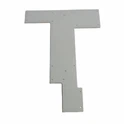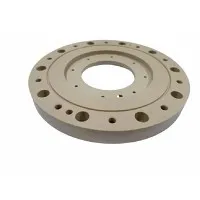

Hey there! I'm a supplier in the business of CNC Machining PEEK, and today I wanna dig into a super interesting question: Can PEEK be machined with a laser cutter in CNC mode?
First off, let's quickly talk about what PEEK is. PEEK, or Polyether Ether Ketone, is one tough cookie in the world of plastics. It's got high mechanical strength, great chemical resistance, and can handle some seriously high temperatures. That's why it's used in all sorts of industries, from aerospace to medical.
Now, onto the main event: laser cutting in CNC mode. CNC, or Computer Numerical Control, is all about using computers to control machine tools with high precision. Laser cutters, on the other hand, use a focused beam of light to cut through materials. When you combine the two, you get a powerful machining method that can create complex shapes with amazing accuracy.
So, can we use this combo on PEEK? Well, the short answer is yes, but it's not as simple as it sounds.
One of the big advantages of using a laser cutter in CNC mode for PEEK is the precision. You can create really detailed parts with tight tolerances. The laser beam is so focused that it can cut through PEEK with minimal material waste. This is great for making small, intricate components where every millimeter counts.
Another plus is the speed. Laser cutting can be pretty fast compared to some other machining methods. This means you can get your PEEK parts produced in less time, which is always a win, especially when you're on a tight schedule.


But, and there's always a but, there are also some challenges. PEEK is a high-performance polymer, and it has a relatively high melting point. When you use a laser cutter, the heat from the laser can cause the PEEK to melt or even vaporize. This can lead to some issues like rough edges, charring, or even warping of the material.
To deal with these problems, you need to carefully control the laser parameters. Things like the power of the laser, the speed at which it moves, and the frequency of the pulses all need to be just right. You also need to make sure the PEEK is properly supported during the cutting process to prevent any movement or vibration that could affect the quality of the cut.
Let's compare PEEK with some other plastics commonly used in CNC machining. For example, CNC Machining PPSU. PPSU, or Polyphenylsulfone, is another high-performance plastic. It's also resistant to heat and chemicals, but it has a different set of properties compared to PEEK. When it comes to laser cutting, PPSU might be a bit easier to work with in some ways because it has a lower melting point. However, PEEK is generally stronger and more durable, so it's still the go-to choice for many applications.
Then there's CNC Machining POM. POM, or Polyoxymethylene, is a more common plastic. It's known for its good mechanical properties and low friction. Laser cutting POM can be relatively straightforward, but it doesn't have the same high-temperature resistance or chemical resistance as PEEK.
And let's not forget CNC Machining Nylon. Nylon is a versatile plastic that's used in a wide range of applications. It's easy to machine, but it's not as strong or heat-resistant as PEEK. When using a laser cutter on nylon, you need to be careful about the heat, just like with PEEK, but the effects might be a bit different because of the different material properties.
So, how do we make the most of laser cutting in CNC mode for PEEK? Well, it starts with having the right equipment. You need a high-quality laser cutter that's capable of handling the demands of cutting PEEK. You also need a good CNC system that can accurately control the laser and move it along the programmed path.
Proper training is also crucial. The operators need to know how to set up the laser cutter, adjust the parameters, and troubleshoot any problems that might arise. They should also be familiar with the properties of PEEK and how it reacts to the laser.
In addition to laser cutting, there are other CNC machining methods that can be used for PEEK. Milling, turning, and drilling are all common techniques. Each method has its own advantages and disadvantages, and sometimes a combination of methods might be the best approach.
If you're in the market for CNC machined PEEK parts, you need to find a reliable supplier. Look for a supplier that has experience working with PEEK and using laser cutting in CNC mode. They should be able to provide you with high-quality parts that meet your specifications.
At the end of the day, laser cutting in CNC mode can be a great option for machining PEEK, but it requires careful planning, the right equipment, and skilled operators. If you have any questions or need more information about CNC machining PEEK, don't hesitate to reach out. We're here to help you get the best possible parts for your applications. Whether you're in the aerospace industry, the medical field, or any other sector that uses PEEK, we can work with you to find the right machining solution.
So, if you're interested in discussing your PEEK machining needs, just drop us a line. We'd love to have a chat and see how we can help you with your projects. Let's work together to turn your ideas into reality!
References:
- "Plastic Materials in Engineering Design" by Reinhold B. Seymour
- "CNC Machining Handbook" by John A. Schey